
Abstract
Modern electronic assembly manufacturing relies on complex global supply chains, making it increasingly important to verify that every assembled component is authentic, expected, and consistent with the intended design. Existing automated inspection approaches typically formulate this problem as a classification task, providing limited insight into the physical evidence supporting their conclusions and often failing to distinguish expected manufacturing variation from genuine hardware integrity events. This paper presents a scenario-based method for hardware integrity verification that formulates component verification as an evidence-based reasoning process. Independent semantic observations and learned visual evidence are extracted from standard manufacturing images and evaluated against the expected observations associated with candidate manufacturing and hardware integrity scenarios, including normal production evolution, approved AVL substitutions, unexpected component changes, and counterfeit-related events. The method was developed using more than 6.5 billion component images collected from high-volume SMT manufacturing and enables transparent, explainable hardware integrity assessments. Representative examples demonstrate that the proposed methodology distinguishes expected manufacturing changes from hardware integrity violations using only standard production images. By automatically inspecting, identifying, verifying, and documenting every component assembled on every PCB, the proposed methodology establishes a practical foundation for component-level hardware assurance. The resulting digital record provides traceable forensic evidence for every assembled component, enabling scalable hardware integrity verification throughout the electronic assembly manufacturing process.
1. Introduction
Electronic assemblies increasingly rely on complex global supply chains involving multiple component manufacturers, distributors, contract manufacturers, and logistics providers [1,2]. As a result, verifying that every assembled component is authentic, approved, and consistent with the intended design has become an essential aspect of electronic assembly manufacturing [3,4,5,6,7]. Hardware integrity violations may arise from counterfeit components, unauthorized substitutions, remarked devices, recycled parts, supply chain mix-ups, manufacturing errors, storage conditions, or other events that cause the assembled hardware to differ from its intended manufacturing specification [8,9,10,11]. Figure 1 summarizes the proposed concept. Similar visual evidence may support different conclusions depending on the expected manufacturing scenario. Instead of searching for anomalies alone, the framework evaluates which hardware integrity scenario is most consistent with the observed evidence.
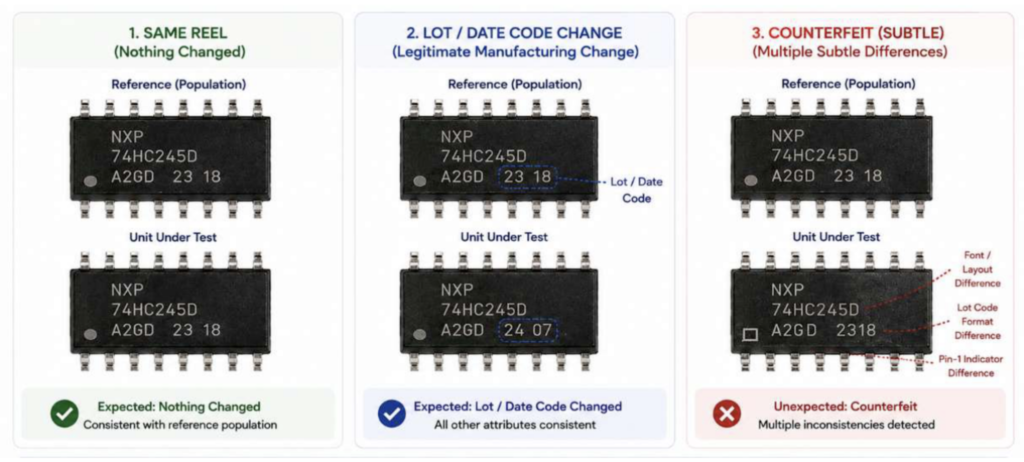
Figure 1. Scenario-based interpretation of manufacturing images. Rather than detecting anomalies alone, the proposed methodology determines which manufacturing or hardware integrity scenario best explains the observed visual evidence, enabling component-level hardware assurance.
Current approaches to hardware integrity verification combine documentation, supply chain traceability, electrical testing, destructive analysis, and forensic inspection. International standards, including SAE AS6171 and SAE AS5553 [10,11,12] for counterfeit detection, define structured inspection procedures for evaluating suspect components. These procedures are fundamentally hypothesis driven. Rather than prescribing a single inspection method, they collect different forms of evidence depending on the suspected scenario [12,13,14]. For example, resurfacing may be investigated using solvent testing, die replacement through decapsulation, and unauthorized substitutions through comparison with authentic reference devices. The objective is not simply to classify a component as authentic or counterfeit, but to determine which explanation is most consistent with the available evidence.
Although these inspection techniques differ considerably, much of the required evidence originates from the external appearance of the component. Manufacturing processes produce characteristic signatures in package geometry, body morphology, lead finish, logos, marking implementation, font characteristics, Pin-1 indicators, and other physical attributes. Likewise, resurfacing, remarking, refurbishment, unauthorized replacement, and environmental degradation frequently alter one or more of these visual signatures. Consequently, manufacturing images already contain a substantial portion of the information required for hardware integrity assessment [15,16,17].
This work is based on the hypothesis that hardware integrity verification can be formulated as an evidence-based reasoning problem operating on manufacturing images. Rather than attempting to directly classify components as authentic or counterfeit, the proposed framework extracts multiple independent pieces of forensic visual evidence, each describing a different physical characteristic of the component. These observations are then evaluated against the expectations associated with candidate hardware integrity scenarios, in a manner analogous to forensic inspection. Figure 2 illustrates the relationship between conventional forensic inspection and the proposed methodology.
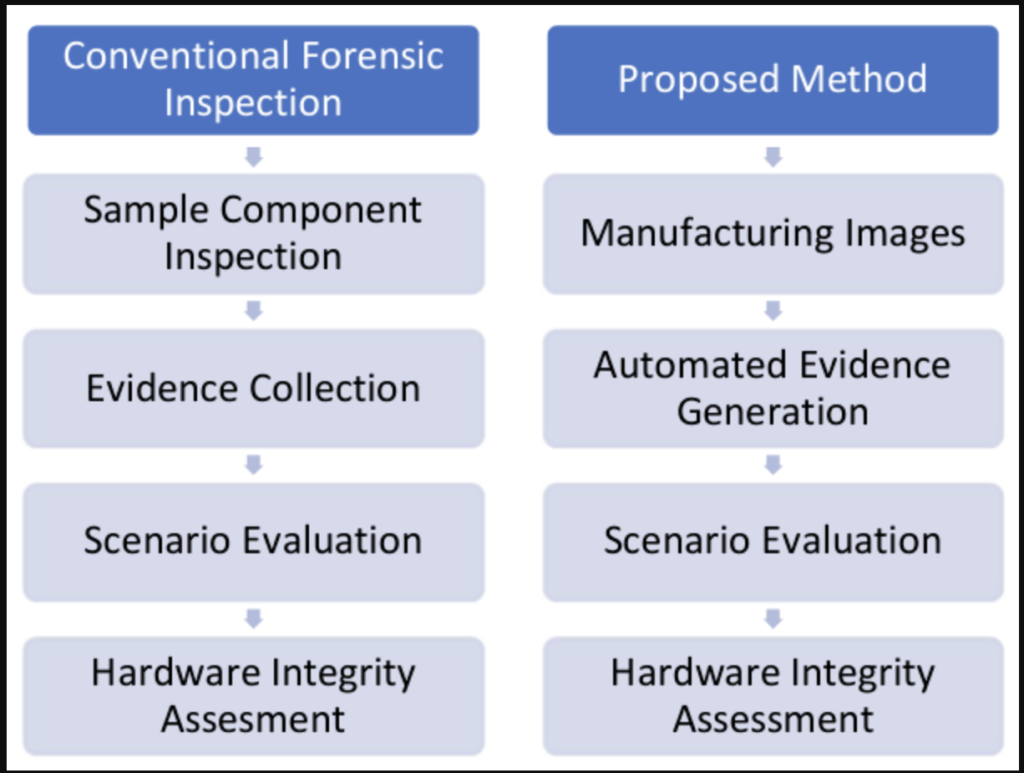
Figure 2. Comparison between conventional forensic inspection and the proposed method. Both approaches evaluate hardware integrity by collecting multiple independent observations and assessing their consistency with candidate hardware integrity scenarios. The proposed method automates evidence generation on all components on the board while preserving and automating the forensic reasoning process.
The proposed method consists of three principal stages. First, independent virtual sensors extract semantic observations and learned visual evidence from standard manufacturing images. Second, the extracted evidence is evaluated against the expected observations associated with candidate hardware integrity scenarios, including normal manufacturing evolution, approved supply chain changes, manufacturing process events, and hardware integrity violations. Finally, the accumulated evidence is integrated into an explainable hardware integrity assessment that identifies both the most consistent scenario and the supporting physical observations.
Read the full article here>>