The FBI recently reported that military components made in Turkey had allegedly been repackaged and presented as U.S.-made, compliant parts before entering the DoD supply chain | It points to a much bigger supply-chain problem: Manufacturers still rely heavily on declarations to tell them what is actually going into their products.
Author: Oshri Cohen, CEO, Cybord
On September 3, 2026, the FBI announced a reward of up to $150,000 for information leading to the arrest and conviction of Onur Simsek, a Turkish national accused of participating in a scheme to supply improperly sourced military components to the U.S. Department of Defense. According to the FBI, a Florida company allegedly presented itself as a vetted and qualified U.S. manufacturer. In reality, the components were manufactured in Turkey, shipped to the United States, and repackaged to make them appear compliant with U.S. production requirements and product specifications. (FBI)
The details make the story even more concerning. According to the Department of Justice, the components were intended for systems including Nimitz- and Ford-class aircraft carriers, Navy submarines, Marine Corps armored vehicles, and U.S. Army tanks. Testing later determined that parts supplied through the scheme did not conform to product specifications. Many were classified as “critical application items”-components whose failure could potentially render an end system inoperable. (Department of Justice)
This particular case is not about electronic components per se, and it is important not to suggest otherwise.
But the lesson for electronics manufacturers could hardly be more relevant.
The supply chain you document isn’t necessarily the supply chain you have
In electronics, the same gap between declaration and reality can exist at the component level. A shipment may arrive with the right paperwork, the right manufacturer name and the right part number – while the physical components tell a different story.
Remarking is one example. Authentic components can have their original markings removed or covered and replaced with new ones – changing a part number, date code, lot code or other identifying information. A used or recycled component can be resurfaced and remarked to appear new. A lower-grade device can be relabeled to appear to meet a higher specification. And counterfeit components can be printed with manufacturer logos and identifiers intended to make them appear authentic. These aren’t hypothetical techniques: remarking and resurfacing are established counterfeit methods addressed explicitly by industry inspection standards such as SAE AS6171/2.
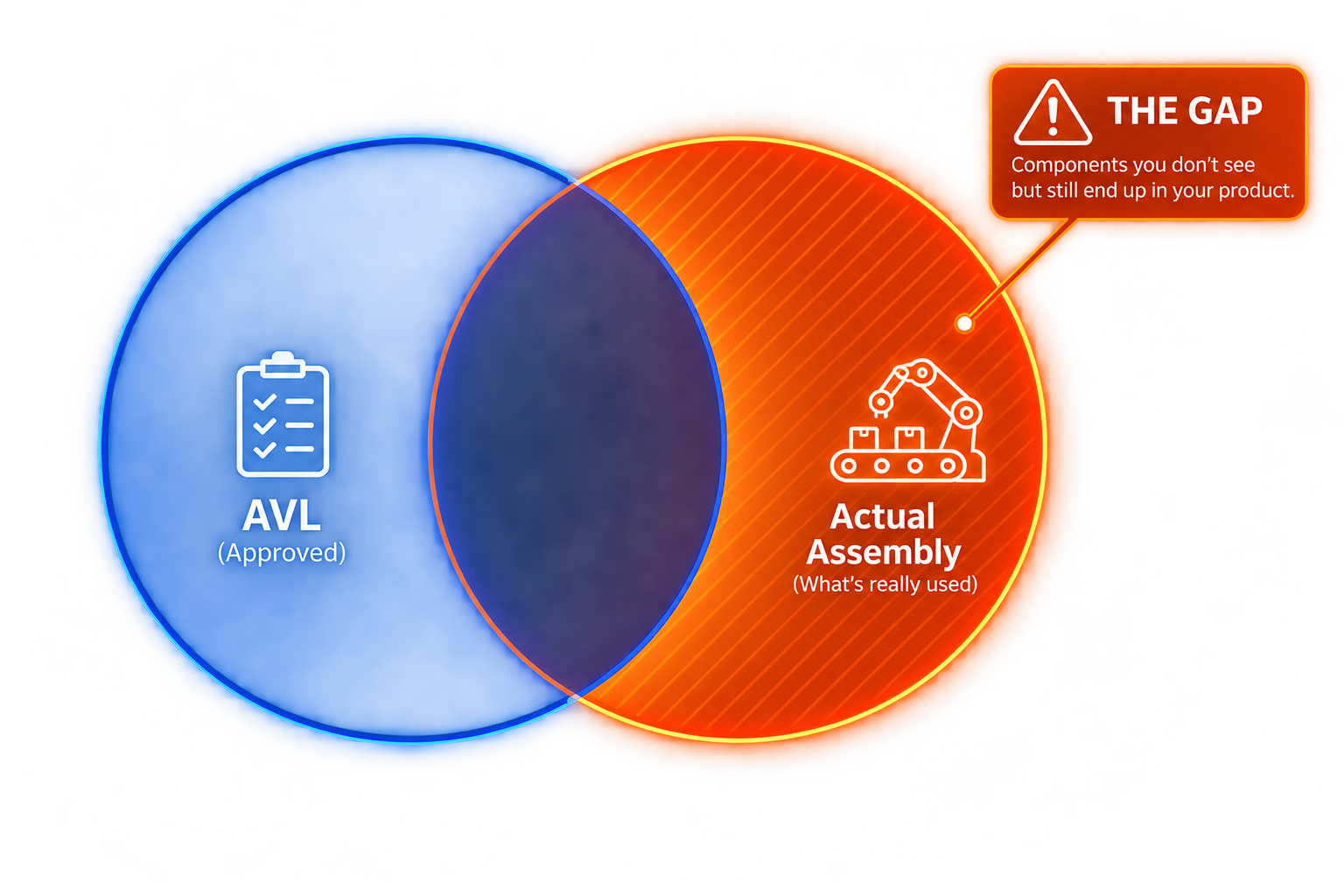
That is why documentation alone cannot provide the complete answer. An AVL tells you what is approved. A BOM tells you what should be assembled. Supplier documentation tells you what was declared. None of them, on their own, proves the identity and provenance of the physical components that actually made it onto the board.
The missing layer is enforcement.
It is not enough to define what is approved; those rules need to be enforced against what actually enters production. That means checking the physical components themselves against the AVL, BOM, provenance and quality requirements – and identifying discrepancies before they become part of the finished product. Enforcement closes the gap between supply chain policy and production reality.
And there is one critical window to enforce what actually goes into the product: on the production line, while the physical components can still be checked against what was approved.
The images below show exactly what the gap looks like – and how it is caught in real time. Components were presented as authentic parts, yet visual comparison against known-good components revealed physical inconsistencies that raised counterfeit concerns. The markings may say the right thing. The paperwork will state the right thing. But the component itself provides another source of evidence, telling a different true.

Declared the same. Physically different. Visual comparison exposes inconsistencies that documentation alone cannot reveal. (Source: Cybord ShieldScan)
A change in what is possible.
For electronics manufacturers, closing the gap between what is declared and what is actually assembled requires more than documentation. It requires the ability to enforce requirements against the physical components entering production.
Until now, doing that at production scale simply wasn’t possible. The industry had to rely largely on supplier declarations, documentation and sampling. Today, AI and production-scale data make it possible to continuously connect supply-chain policy with the physical reality of what is actually being built.
Production already generates enormous amounts of information about components and assembled boards. When that data is captured and analyzed systematically using AI capabilities, it creates an independent evidence layer – making it possible to identify when production reality doesn’t match supply-chain policy, and act when it matters: before the product leaves the line.
The gap is not theoretical. One OEM, identified hundreds of thousands of quarterly mismatches between declared traceability data – the “traced MPN” – and the components physically assembled on production lines. As the manufacturer introduced enforcement mechanisms based on big-data and driven by AI, those mismatches declined dramatically, turning traceability from a record of what should have happened into evidence of what actually happened (the temporary increase in Q2–Q3 2025 reflects the addition of new product lines to the system. As enforcement was extended to those lines, mismatch levels declined again).

Traceability vs. reality: Component mismatches identified between declared production records and what was physically assembled. As enforcement was introduced, mismatches fell from hundreds of thousands per quarter to fewer than 20,000 (Source: Cybord AI).
And enforcement is only the beginning.
Manufacturers can enforce AVL compliance instead of assuming it, identifying components that don’t match approved sources before they become part of the finished product.
Instead of relying exclusively on declared provenance, they can create component-level evidence supporting manufacturer, country-of-origin, date-code and lot-code verification.
And at sufficient scale, that evidence becomes more than a compliance record. It becomes supply-chain intelligence.
Manufacturers can see whether approved second sources are actually being used, whether production is becoming concentrated around one supplier or geography, whether sourcing patterns are changing, and where hidden dependencies are emerging.
Trust – but verify at production scale
The lesson from the FBI case isn’t that supplier declarations or certifications are useless. Quite the opposite. They are essential parts of supply-chain governance.
The lesson is that declaration without independent verification leaves a gap between policy and reality.
And in critical industries-defense, aerospace, data-center infrastructure, medical devices, automotive and others-the consequences of that gap can extend far beyond procurement.
They can become quality problems, compliance violations, production disruptions, security vulnerabilities and, ultimately, business or mission risks.
The electronics industry has spent decades getting better at defining what should go into a product.
The next step is being able to ensure that this is what actually happens – and anticipate where new risks might emerge.
The progression is important:
Enforce what is approved. Authenticate what was actually built. Predict where supply-chain risk could emerge next.