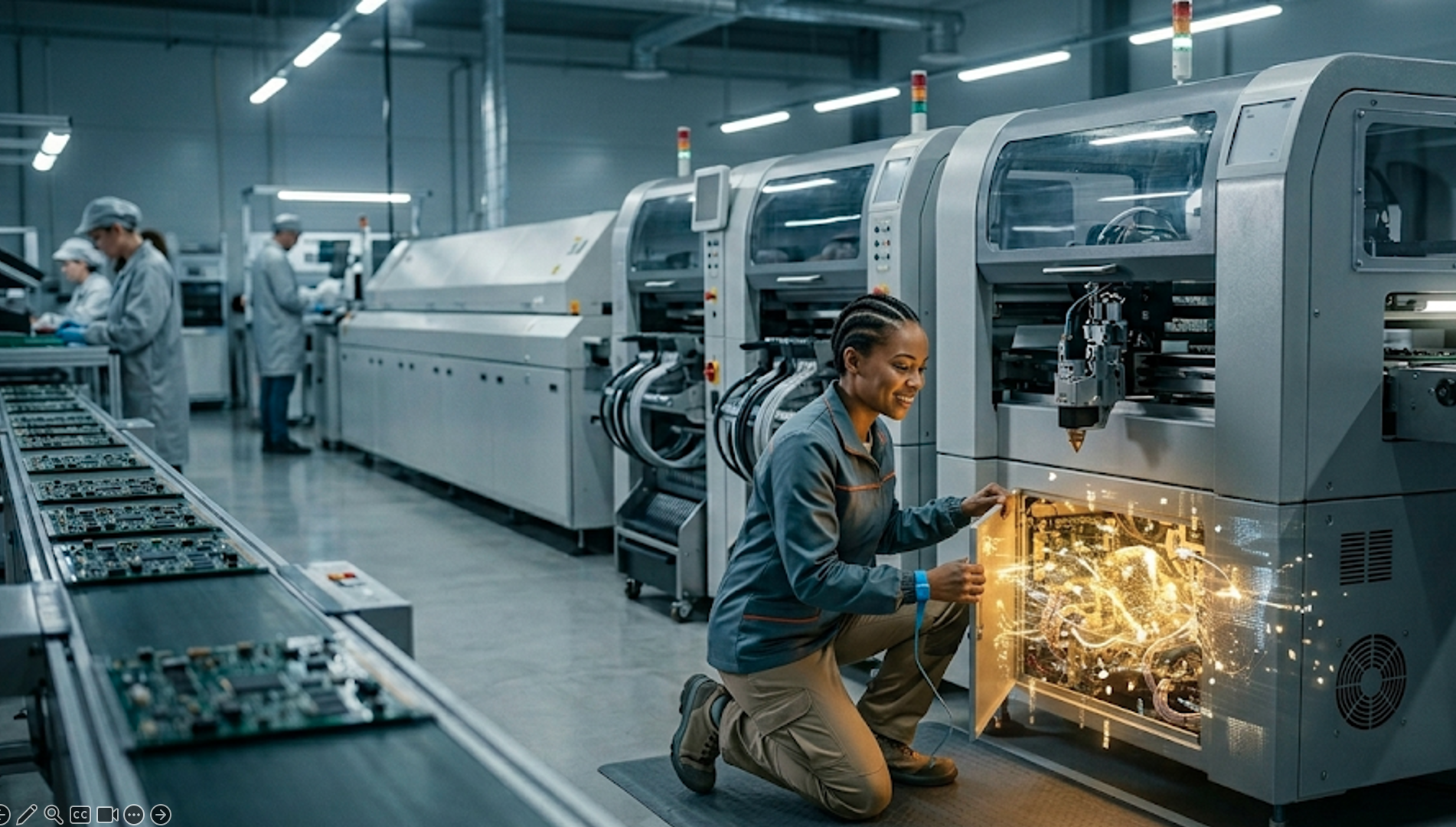
There is a running joke in manufacturing circles that the two most expensive pieces of equipment on a production floor are the coffee machine and the data historian, because one gets used constantly, and the other barely gets opened. The joke lands because it’s true. Electronics manufacturers sit on top of one of the richest untapped data assets in modern industry, and most of them don’t know it.
Every SMT production line is a data-generating machine. Every pick-and-place cycle snaps an image of every component, and then immediately discards it. Once the machine uses the image for alignment, it’s gone. Every reel carries embedded intelligence: lot codes, date codes, manufacturer identifiers, country of origin. Every board that rolls off the line has a complete, component-by-component assembly history locked inside the production process itself. In a typical environment, a single line processes around one million components per day. Multiply that across multiple lines, multiple shifts, and multiple facilities, and the scale of what’s being generated – and thrown away – is extraordinary.
The problem isn’t that the data doesn’t exist. It’s that most companies don’t even have a process to store it, let alone read it, structure it, and put it to work. Until now.
Unlocking What’s Already There
Visual AI changes the equation entirely. Not by adding new sensors or new steps, but by making the cameras that already exist on SMT equipment intelligent. Pick-and-place machines capture bottom-side images of every component as part of their standard operation. But today those images are discarded after alignment. AOI systems image every assembled board, but only inspect specific pre-fixed areas, never creating a full contextual picture of the entire assembled board. These images have always been there. What Visual AI does is intercept them, preserve them, and transform them from raw visual data into structured, queryable intelligence.
The result is a continuous stream of verified, component-level data: manufacturer part numbers confirmed against the Approved Vendor List, lot and date codes accurately read and recorded, component authenticity verified against a database of billions of known components, defect flags raised in real time, quality scores assigned at both the component and reel level, and every data point linked to a specific board serial number and reference designator. Information that previously vanished into the production process is now captured, organized, and accessible – through a management console, or injected directly into existing MES or BI systems via API.
This alone represents a significant operational shift. Quality teams can query production history by board, by supplier, by component type, or by date range. Root cause analysis that once took days of manual investigation can now be completed in minutes. Epidemic behavior, where multiple defective components from the same reel are assembled across multiple boards, is flagged automatically before it becomes a systemic problem, rather than discovered after the fact.
The Bigger Picture: Data That Flows Upstream and Downstream
The real opportunity lies beyond the production floor. Component-level data from the SMT line becomes exponentially more valuable when it flows into the broader operational and business intelligence ecosystem. And even more so when it is coupled with AI data agents that can act on it in real time. Three examples illustrate what this looks like in practice:
- Quality-Driven Procurement: If Visual AI detects a batch defect on the line, data intelligence agents can immediately reroute global sourcing to validated alternatives, closing the loop between what’s happening on the floor and what’s being ordered from suppliers.
- Shortage Preemption: As data agents flag a coming shortage, the OEM’s AVL is updated instantly and that information is passed directly to the Visual AI enforcement mechanism on the line. Your physical builds never skip a beat, even as the supply landscape shifts beneath you.
- Data-Based Decision Making: Gain the visibility needed to trim supplier bloat and leverage actual verified usage data for better global contract negotiations, replacing assumptions with evidence.
From Black Box to Business Intelligence
The SMT line has long been treated as a black box; A place where materials go in and boards come out, with limited visibility into what happens in between. Visual AI removes that opacity, but its full value is realized only when the data it generates is treated as a strategic asset rather than a quality control byproduct.
The manufacturers who understand this first will have a genuine advantage: cleaner supplier relationships, smarter procurement, faster response to disruption, and a level of operational intelligence that compounds over time as the data pool grows.
The goldmine has always been there. The tools to extract it now exist. The question is who moves first.