The electronics industry has long been governed by a dangerous disconnect.
On one side is the global supply chain: a volatile web of distributors, brokers, and shifting market signals. On the other is the physical factory floor, where the ground truth of what is actually being built often remains a mystery until it is too late.
For the modern OEM and EMS, managing this gap with fragmented tools is a massive financial risk. Relying on paper trails to verify million-dollar production runs is a relic of the past.
Today, that gap closes.
We are proud to announce a strategic partnership between Parter and Cybord. By unifying Parter’s AI-native supply chain intelligence with Cybord’s Visual AI inspection, we are delivering the industry’s first End-to-End Hardware Lifecycle Intelligence.

Phase 1: AI Supply Chain Intelligence with Parter
Building a resilient enterprise starts months before a component touches the assembly line. Every part on your Bill of Materials (BOM) is a potential point of failure. Whether it is obsolescence, sudden tariff spikes, or supplier volatility, the risks are constant.
Parter replaces manual monitoring with autonomous AI agents. Parter synthesizes global inventory data, compliance shifts, and market whispers into a single source of truth. You do not just see your supply chain. You anticipate it.
- The Result: You know exactly what to buy, when to buy it, and where the hidden risks live.
Phase 2: AI Visual Inspection with Cybord
Planning the perfect BOM is a strategic victory, but reality happens on the line. At Cybord, we bring the Ground Truth to life by utilizing the cameras already inside your SMT lines to analyze every single component in real-time.
We generate a Digital Birth Certificate for every board, verifying:
- Authenticity: Zero-trust verification of every component.
- Provenance: Exact traceability from lot codes to country of origin.
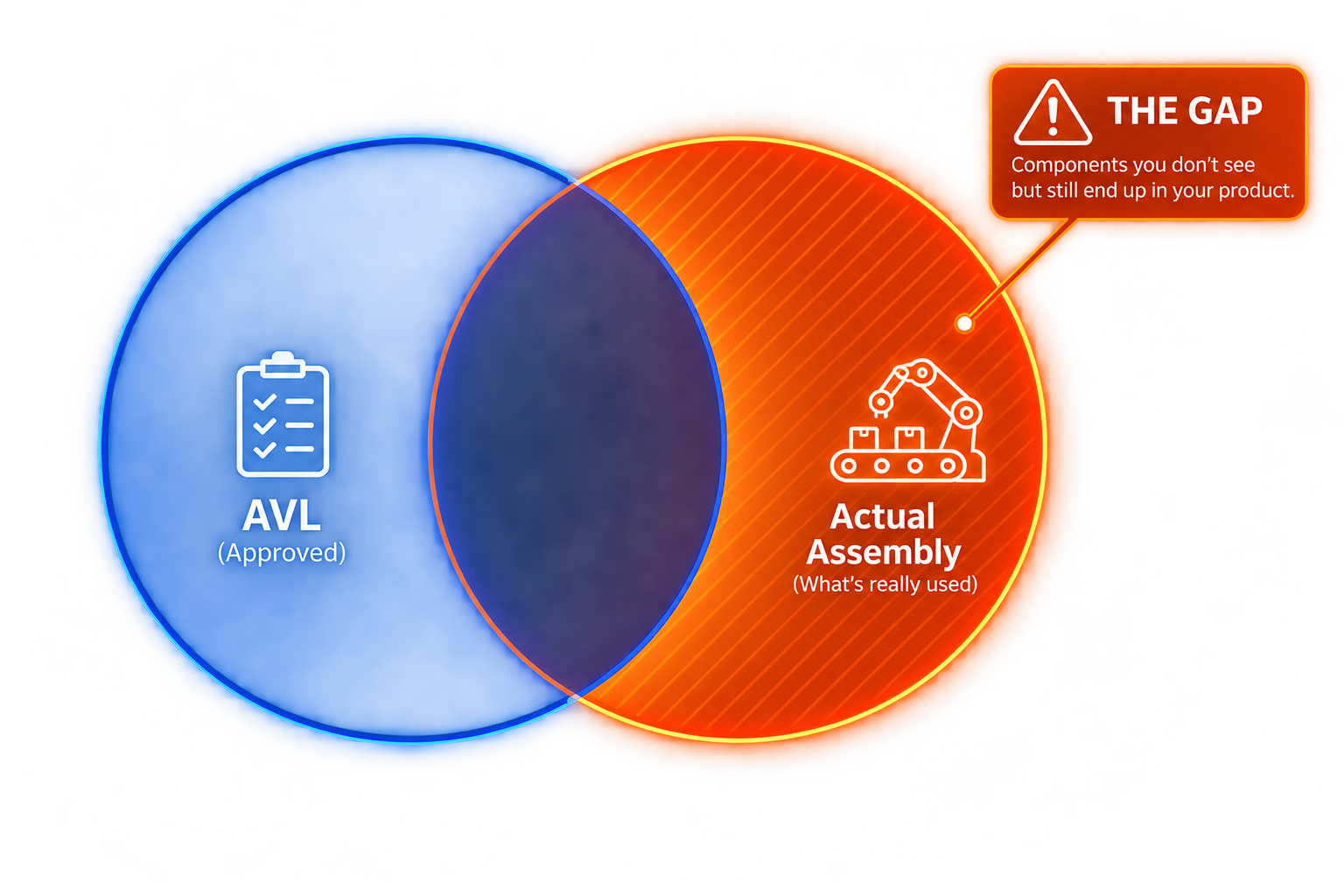
- Compliance: Instant AVL enforcement at the point of placement.
The Power of the Loop: Sourcing Meets Solder
The true disruption happens when these two engines sync. This is an automated feedback loop for the C-Suite:
- Quality-Driven Procurement: If Cybord detects a batch defect on the line, Parter’s intelligence immediately reroutes your global sourcing to validated alternatives.
- Shortage Preemption: As Parter flags a coming shortage, your AVL is updated instantly. This ensures your physical builds never skip a beat.
- Continuous Control: AVL compliance is continuously enforced with Cybord’s visual inspection of every component.
- Consolidated Power: Gain the visibility needed to trim supplier bloat and leverage actual usage data for better global contract negotiations.
Witness the Future at Apex Expo
The era of assuming your supply chain is secure is over. The era of Clarity has arrived.
If you are attending Apex Expo next week, join us to see how the Parter and Cybord ecosystem is redefining what it means to build with confidence.
- Visit Cybord at Booth #1329
- Visit Parter at Booth #4447