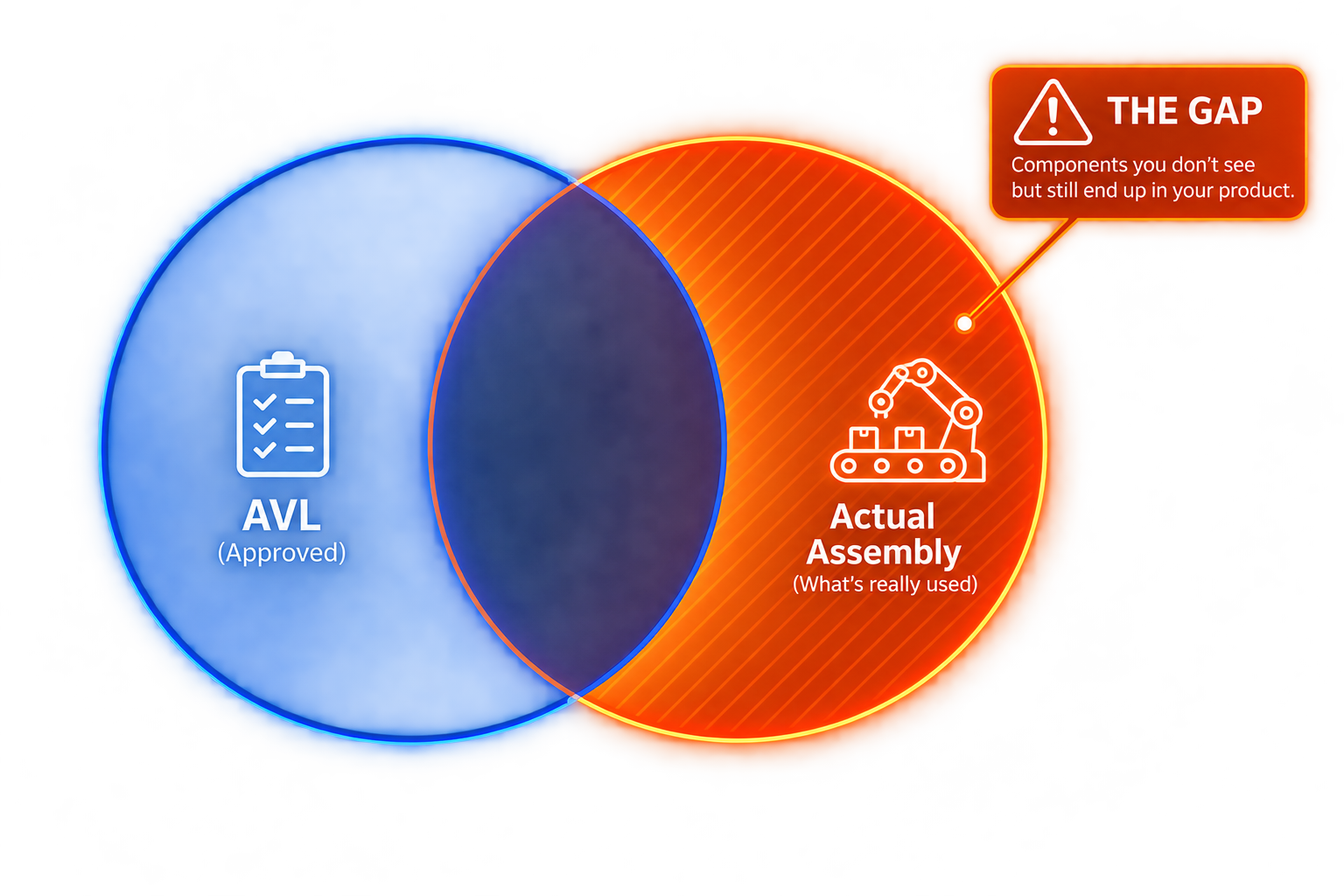
For years, an electronic device could receive FCC authorization even if it contained critical components from a restricted manufacturer, provided the finished device itself was not produced by a company on the FCC’s Covered List.
That loophole has now been closed.
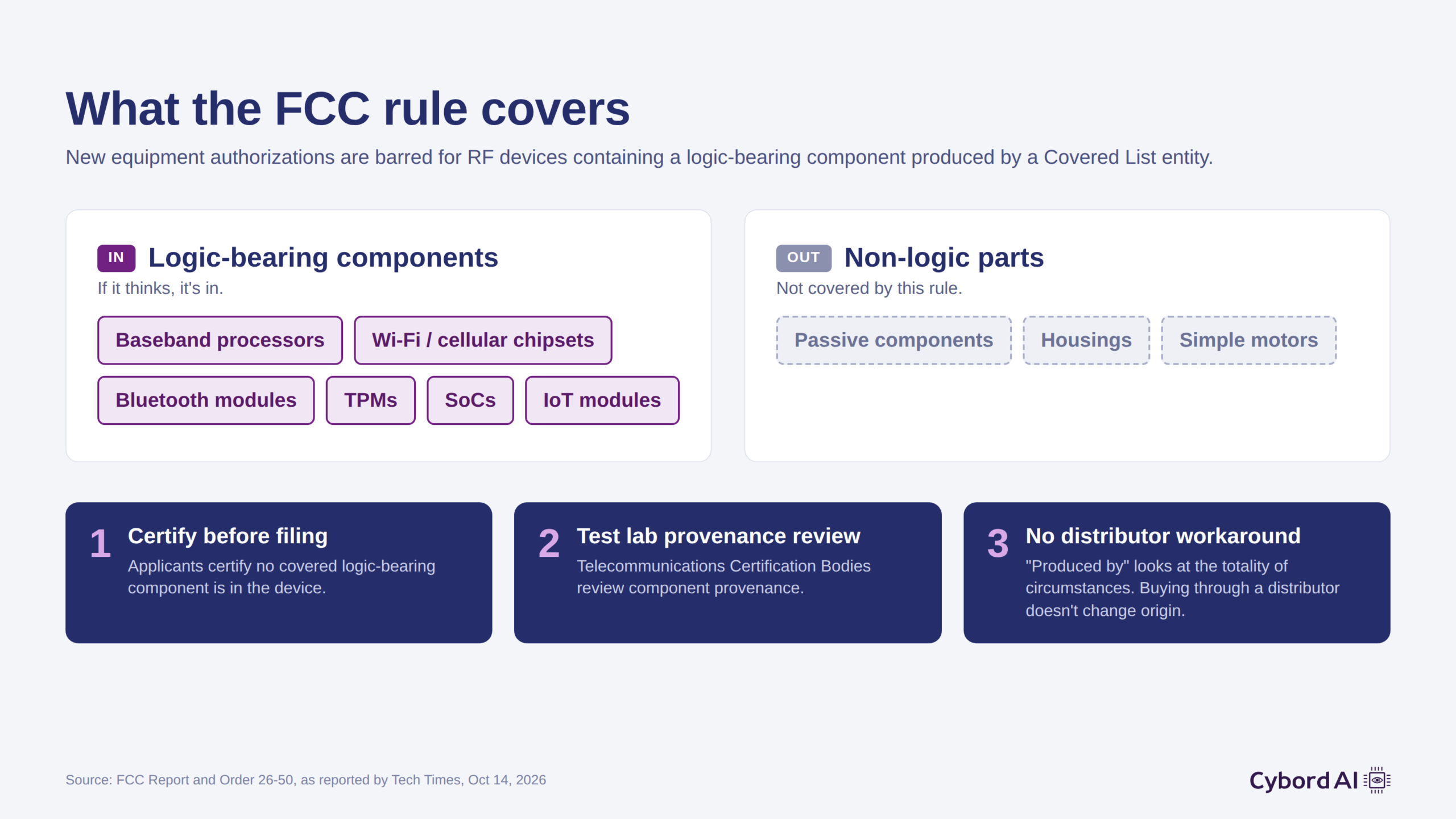
On October 13, FCC Report and Order 26-50 took effect, restricting new equipment authorizations for certain radio-frequency devices containing logic-bearing components produced by Covered List entities, including Huawei and ZTE1.
This is a significant development. But the bigger story is not about Huawei or ZTE.
It’s about a fundamental weakness in how the electronics industry manages its supply chain: the difference between what manufacturers believe is on their boards and what is actually there.
And that difference is becoming a compliance risk.
The FCC Is Looking Inside the Box
The new rule extends scrutiny beyond the manufacturer of the finished device to the components inside it.
It covers logic-bearing hardware such as processors, wireless chipsets, Bluetooth modules, systems-on-chip and other components capable of processing or transferring data. Passive components are outside the current restriction.
For OEMs seeking new equipment authorization, this creates an additional responsibility: establishing that their products do not contain prohibited components.
Certification bodies must take component provenance into account. And purchasing through an intermediary does not change the underlying origin of a restricted component.
The rule also has important transitional provisions for previously authorized equipment and pending applications. But the direction is clear.
Knowing who assembled your product is no longer enough. You need to know who made the components inside it.
That sounds straightforward. In practice, it is anything but.
What FCC Order 26-50 Covers
Your BOM Is Not Your Board
Most OEMs have well-established supply-chain control processes.
They maintain approved vendor lists, bills of materials (BOM), supplier declarations, purchasing records and certificates of conformance.
These are important tools. But they have a fundamental limitation.
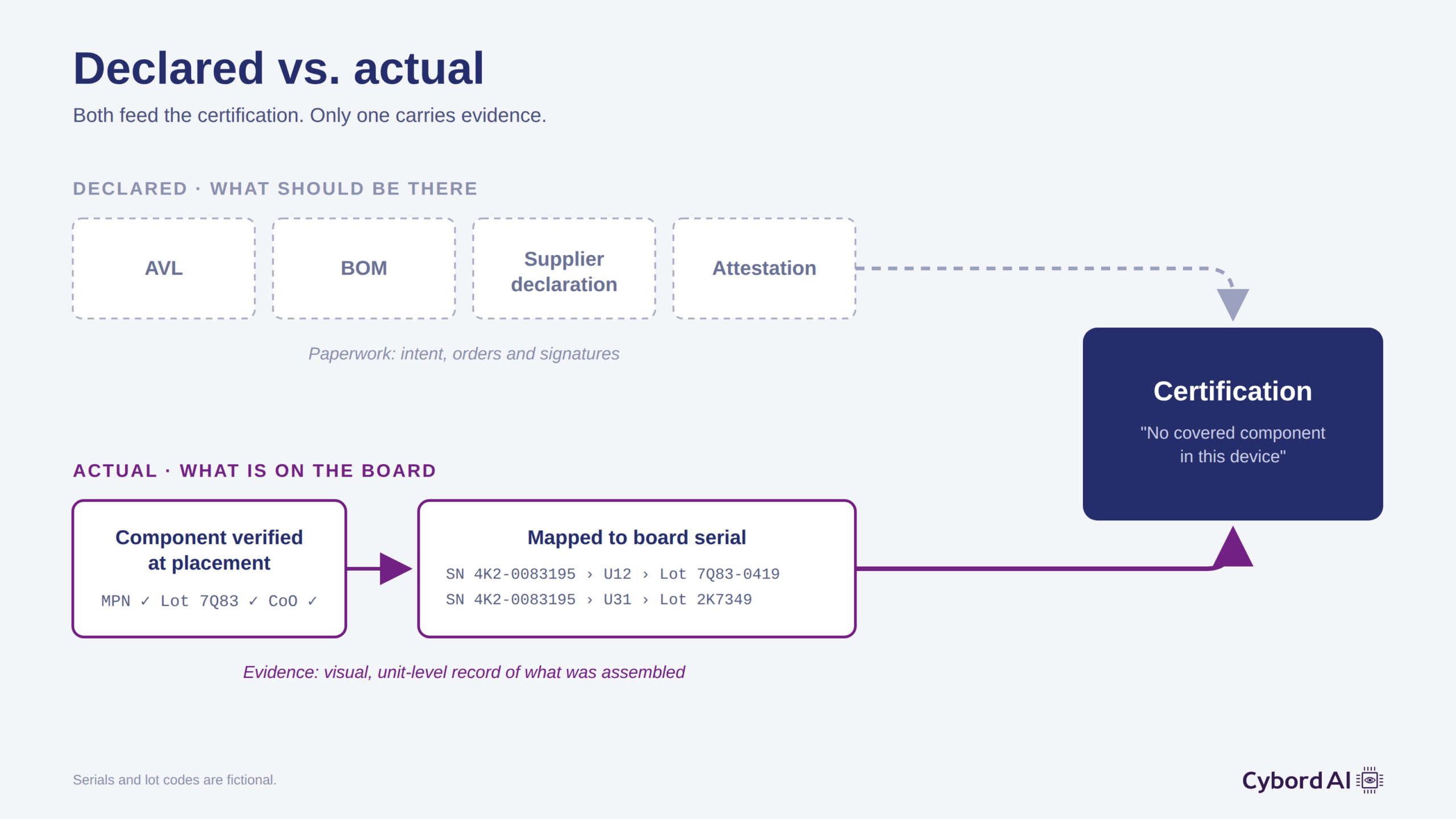
They document what was approved, ordered or reported. They don’t necessarily verify what was actually assembled.
Components can be substituted. Suppliers can change. Materials can arrive from unexpected sources. And across multiple EMS partners and manufacturing locations, the gap between planned and actual component consumption can become substantial.
Traditional automated optical inspection was designed primarily to detect assembly defects, not establish component provenance. ERP systems track transactions, not the physical identity of every component placed on a board.
An approved vendor list tells you what should be there. Actual component consumption tells you what is there.
That distinction is no longer just an operational concern. It has direct implications for compliance, product security and market access.
A Warning From Taiwan
Just one day before the FCC rule took effect, news emerged from Taiwan that illustrates the consequences of losing control over component origin.
On October 12, Taiwanese authorities reported the detention of two executives at drone supplier Jiin Ming Industry. Prosecutors allege that prohibited Chinese-made chips and camera lenses were used in drones supplied under military procurement contracts.2
The executives are also suspected of submitting falsified business records. The investigation is ongoing.
This is not an FCC case, and the allegations have not been proven in court. But it highlights the same fundamental exposure.
A product can be delivered with components that violate procurement requirements, while the supporting documentation presents a different picture.
By the time such discrepancies are uncovered, the products may already have been delivered or deployed.
The lesson for electronics manufacturers is simple:
Compliance cannot depend exclusively on trusting the paperwork.
From Supplier Declarations to Physical Evidence
The electronics industry has spent decades improving its ability to trace purchasing, inventory and production.
But traceability is not the same as verification.
Knowing which components were purchased does not automatically establish which components were assembled into a specific product.
This is where the next evolution of supply-chain control needs to happen.
At Cybord AI, we believe component verification must become an integral part of electronics manufacturing, not an occasional audit or an investigation after something goes wrong.
Our solution analyzes printed curcuit board assembly images captured by existing inspection equipment on the production line, identifying component markings and other visual characteristics and comparing them against expected component information.
Combined with production and traceability data, this creates a much clearer picture of the components actually used in manufacturing.
It delivers three critical capabilities:
- Enforce Supply Chain Compliance – Detect unexpected or unauthorized components during manufacturing, including substitutions that conflict with approved vendor lists or sourcing policies.
- Establish Component-Level Traceability – Connect verified component information to the boards and products being manufactured, creating unit-level evidence that goes beyond supplier declarations.
- Turn Consumption Data Into Supply Chain Intelligence – Understand which components are actually being consumed across manufacturing sites and EMS partners. Identify sourcing deviations, substitution patterns and supplier dependencies before they become larger problems.
This is not about adding another layer of paperwork.
It’s about replacing assumptions with evidence.
Declared vs. Actual – What it Actually Means
The Question Every OEM Should Be Asking
If you manufacture RF-enabled products for the U.S. market, the immediate question is not whether you have an approved vendor list or a documented sourcing policy.
Of course you do.
The question is whether you can demonstrate that the components actually assembled into your products comply with those policies.
And whether you can do it consistently, across production lines, manufacturing sites and EMS partners.
The FCC’s latest decision is another indication that component-level visibility is moving from an operational advantage toward a strategic necessity.
For OEMs, the challenge is to close the gap between intended and actual production before it becomes a compliance issue.
Compliance is the immediate challenge. Taking control of your supply chain is the strategic imperative.
Q & A
1. What is FCC Report and Order 26-50, and how does it affect electronics manufacturers?
FCC Report and Order 26-50, effective October 13, 2026, closes the “component part loophole” by restricting new U.S. equipment authorizations for certain radio-frequency devices containing logic-bearing components produced by entities on the FCC’s Covered List, including Huawei and ZTE. The rule extends regulatory scrutiny beyond the finished device to its internal components, requiring OEMs to strengthen component provenance and supply chain compliance processes.
2. Why are traditional BOMs and supplier declarations insufficient for FCC component compliance?
Bills of materials (BOMs), approved vendor lists (AVLs), and supplier declarations document which components were approved, ordered, or reported, but do not necessarily verify which components were actually assembled into a product. Unauthorized substitutions, sourcing deviations, and manufacturing discrepancies can create gaps between intended and actual production. OEMs need reliable component-level evidence to demonstrate compliance and reduce supply chain risk.
3. How does Cybord AI help OEMs address FCC 26-50 compliance and component provenance risks?
Cybord AI uses Visual AI to inspect electronic components during manufacturing, helping OEMs verify component identities and detect discrepancies between approved sourcing policies and actual production. Its platform enables manufacturers to enforce supply chain compliance, authenticate components through visual evidence and traceability, and predict emerging supply chain risks through production intelligence. This helps OEMs move beyond documentation-based assurance toward proactive supply chain control, although Cybord AI does not itself constitute FCC certification.
Source:
1 – Tech Times — FCC Rule Takes Effect: Huawei and ZTE Chips Now Block Devices From U.S. Authorization
2 – Drone Firm Execs. Detained Over Alleged Use of Chine Made Chips