On October 19, TP-Link Systems announced plans to assemble its next-generation Wi-Fi 8 routers in Corinth, Mississippi, through a partnership with U.S. contract manufacturer Key Tronic. If regulatory approvals proceed, production could begin in 2027.
The move follows new FCC restrictions on foreign-produced consumer routers, making domestic assembly an increasingly attractive option for companies seeking access to the U.S. market.
But there’s a catch.
TP-Link has acknowledged that many of the components going into those American-assembled routers will still come from overseas.
And that raises a question extending well beyond TP-Link:
If you move your manufacturing to America but your components still come from the same global suppliers, how much has your supply chain really changed?
The Geography of Assembly Is Not the Geography of Risk
Reshoring is gaining momentum. Governments want greater domestic manufacturing capacity. OEMs want shorter supply chains, reduced geopolitical exposure and more control over production.
These are legitimate objectives.
But moving the final assembly operation doesn’t necessarily change the underlying dependencies.
A router assembled in Mississippi can still rely on semiconductors fabricated in Asia, optical components sourced from China, and specialized materials available from only a handful of suppliers worldwide.
The same applies to automotive electronics, aerospace systems, medical devices and industrial equipment.
A product may carry a domestic assembly designation while much of its critical technology remains dependent on overseas manufacturing.
There’s nothing inherently wrong with global sourcing. Modern electronics manufacturing depends on it.
The problem begins when companies confuse domestic assembly with supply chain independence.
Reshoring Can Move the Factory Without Moving the Risk
Consider an OEM relocating production from Asia to the United States.
The company invests in a new manufacturing partner, qualifies production lines, adjusts logistics and establishes local operations.
On paper, its manufacturing footprint has changed significantly.
But what happens to its component supply?
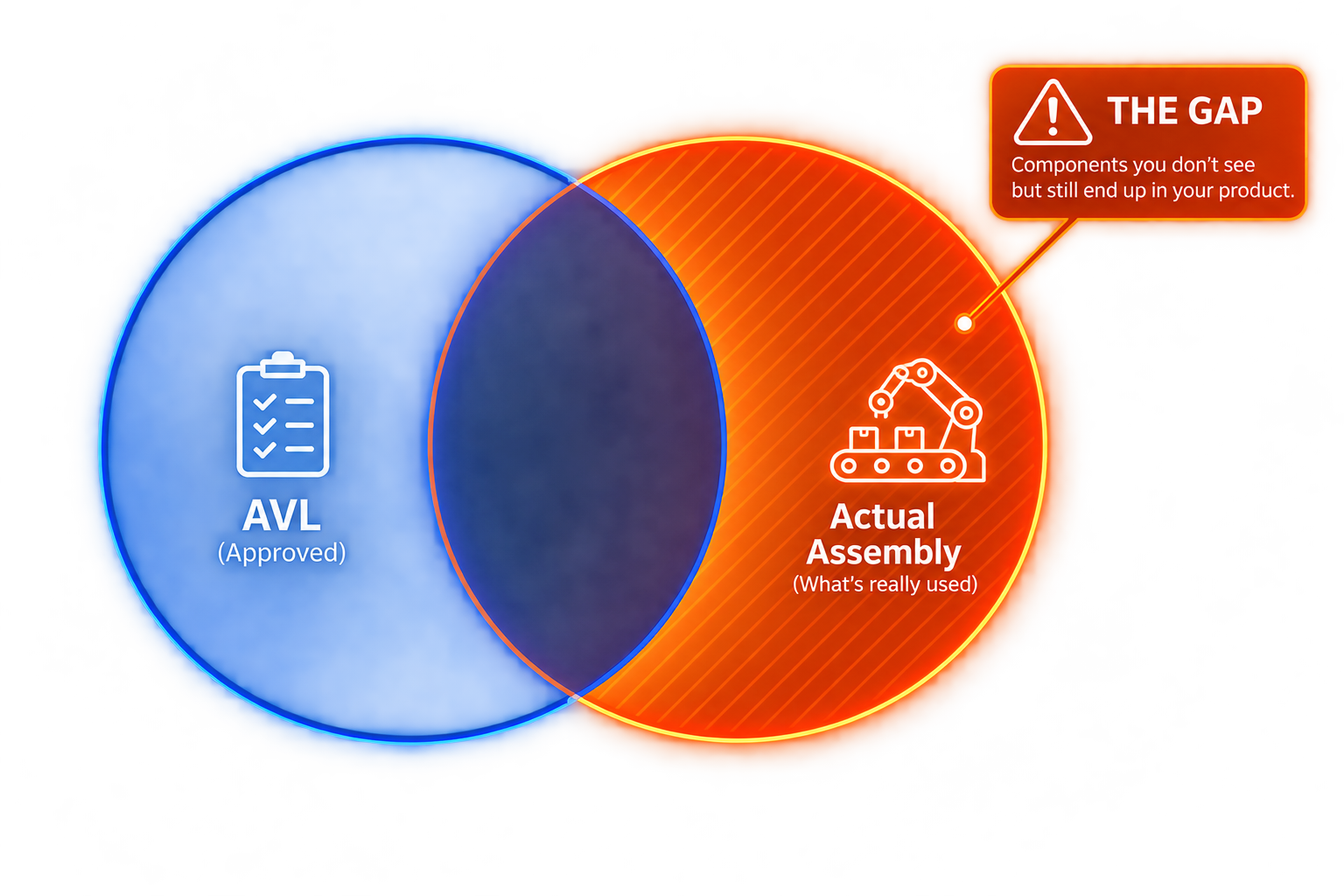
The same critical semiconductor may still come from a single overseas fabrication facility. Alternative suppliers may exist in the approved sourcing plan but account for almost none of the actual production volume.
And as the new manufacturing operation ramps up, component substitutions and changes in supplier allocation can introduce dependencies the OEM never anticipated.
The result is a paradox: a company can invest millions in reshoring while retaining much of the supply chain exposure it was trying to reduce.
This is why reshoring strategies need to be evaluated against actual component sourcing, not simply the location of the assembly plant.
The meaningful measure of resilience isn’t how many factories you’ve moved. It’s whether you’ve reduced your exposure to critical suppliers, locations and components that could disrupt production.
Regulation Is Making the Distinction Harder to Ignore
Recent U.S. policy developments are reinforcing this reality.
The FCC has introduced restrictions affecting foreign-produced consumer routers and certain devices containing components from restricted manufacturers. Meanwhile, proposed Senate legislation targeting Chinese-made optical transceivers highlights growing concern about the origins of critical networking hardware.
These measures differ in scope and legal status. But together, they signal a growing interest in what lies beneath the finished product.
For manufacturers, that introduces a new dimension to reshoring decisions.
A domestic assembly operation may help satisfy one regulatory requirement while leaving other sourcing restrictions, component-origin questions or supply chain vulnerabilities unresolved.
Changing the address of the factory is not the same as changing the risk profile of the product.
And those risks aren’t confined to the networking industry.
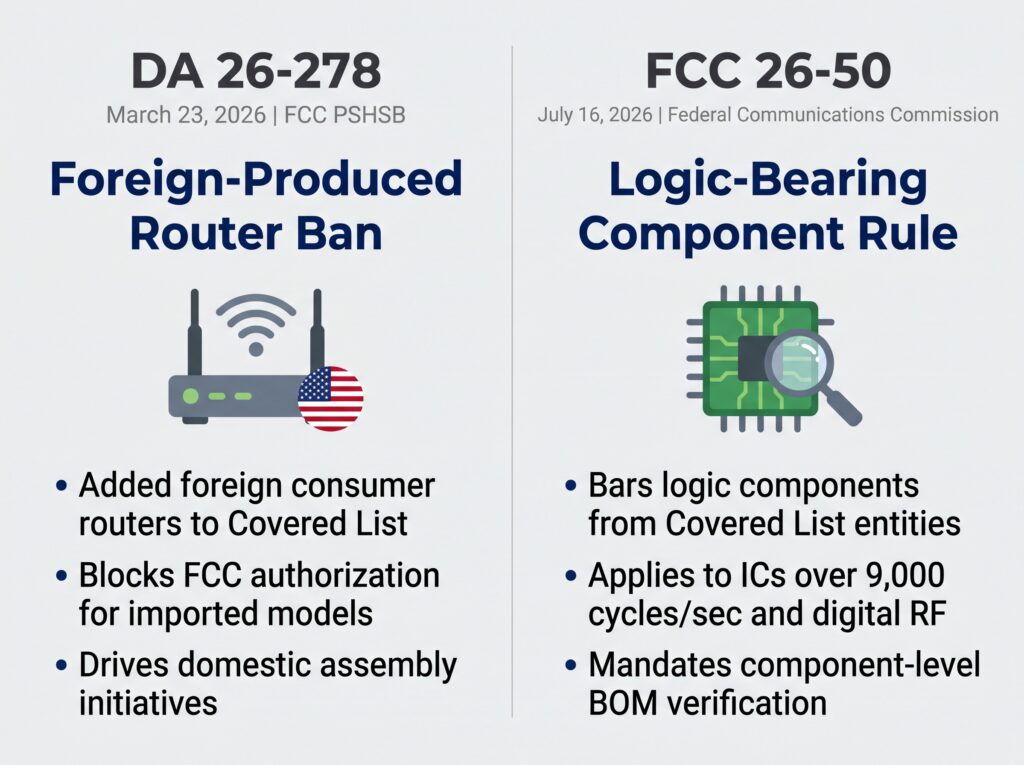
Assembled in America, but built from what? Two major 2026 FCC rulings show why domestic assembly is no longer synonymous with supply chain compliance.
The Missing Dimension in Reshoring Strategy
For most OEMs, reshoring decisions are driven by familiar metrics: labor costs, tariffs, transportation, capacity, lead times and proximity to customers.
But there’s another dimension that deserves equal attention: the composition of the actual supply chain.
Where are critical components really coming from? How concentrated is production among suppliers and manufacturing locations? Are approved alternatives genuinely being used, or do they exist only as contingency plans?
And how does that picture change when production moves between sites or contract manufacturers?
These are not questions that can be answered by looking at factory locations alone.
They require intelligence drawn from actual manufacturing activity.
This is where Cybord AI changes the equation.
By analyzing components used in production and connecting that evidence across manufacturing sites, Cybord gives OEMs the ability to:
Enforce approved sourcing policies consistently, even as manufacturing footprints change.
Authenticate the components used in production and establish evidence of product provenance.
Predict emerging supply chain risks by identifying geographic concentration, supplier dependencies and changes in actual component consumption.
For an OEM planning a manufacturing move, that means being able to evaluate whether its new supply chain is genuinely more resilient – rather than assuming it is because the assembly location has changed.
It also means identifying vulnerabilities that may have remained hidden across years of established production.
From Reshoring to Resilience
Bringing electronics manufacturing back to the United States can deliver real strategic benefits. Domestic production capacity matters, particularly in industries where supply continuity, national security and product integrity are critical.
But reshoring should not be confused with resilience.
Resilience comes from understanding your dependencies, controlling what enters your products and anticipating where the next disruption may emerge.
That requires visibility beyond the assembly plant and intelligence beyond procurement records.
The real measure of a successful reshoring strategy isn’t simply where your products are assembled. It’s whether you have gained greater control over the supply chain behind them.
Because moving the factory is a geographic decision. Reducing the risk is a strategic one.
# # #
Q&A
Q: What do the recent FCC rules (DA 26-278 & FCC 26-50) require?
A: Recent FCC measures are increasing scrutiny of both where electronic products are manufactured and who produces their critical components. Moving final assembly to the United States does not automatically resolve restrictions related to component sourcing.
Manufacturers must distinguish between the location of final assembly and the origin of the components used in production. Cybord AI helps OEMs enforce approved sourcing policies by verifying electronic components during manufacturing, identifying unauthorized substitutions, and detecting discrepancies between approved and actual production.Q: How does Cybord help OEMs achieve true supply chain compliance?
Q: Does assembling an electronic product in the United States guarantee that its components are domestically sourced?
No. A product assembled in the United States may still contain semiconductors and other critical components manufactured overseas. Domestic assembly establishes where the finished product was put together, not necessarily where its components originated.
Cybord AI helps manufacturers authenticate what actually goes into their products through component-level verification and micro-traceability. By capturing evidence of component identity, manufacturer, date and lot codes, and available origin information, OEMs can establish auditable records of their products’ actual composition rather than relying exclusively on procurement records or supplier declarations.
Q: How can manufacturers determine whether reshoring production actually reduces supply chain risks?
Reshoring does not necessarily eliminate dependencies on foreign suppliers, single-source components, or geographically concentrated manufacturing facilities. Manufacturers need to evaluate actual component sourcing across production sites, rather than assuming that relocating assembly automatically improves resilience.
Cybord AI transforms component-level production data into supply chain intelligence, helping OEMs identify hidden supplier dependencies, geographic concentration, differences between planned and actual sourcing, and changes in component consumption over time. These insights help manufacturers anticipate vulnerabilities and determine whether reshoring has genuinely reduced supply chain exposure.
# # #
Sources:
TP-Link bends over backwards to keep its U.S.-based router business afloat
Here’s why the Wi-Fi camp is freaking out about the FCC’s new router policy