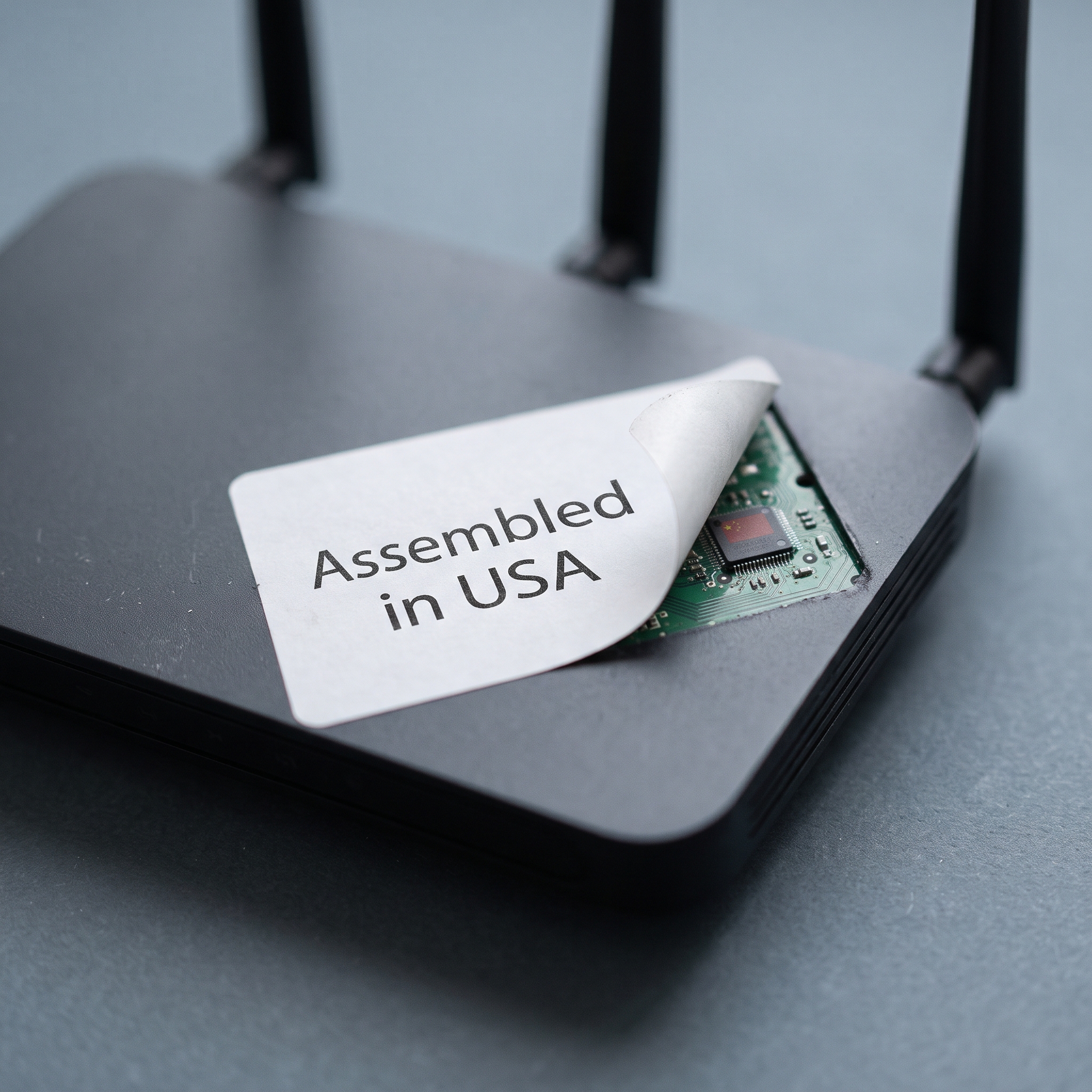
This week, a sponsored post in a leading electronics trade publication made a bold promise(1). The chips others cannot secure, they can. Scarce analog parts. End-of-life parts. Even GPU allocation in under three months.
It isn’t the only pitch like it. As allocation tightens, the market becomes more dependent on brokers, and pitches like this one land on the desk of a procurement team under pressure to keep a line running.
The hard reality is this: parts that are hardest to find are exactly the parts counterfeiters go after first. And as the above-mentioned post rightly states, “the tougher the market, the more willing some are to cut corners.”
Component scarcity is the counterfeiter’s business model
Counterfeiting follows demand. When lead times stretch from weeks to months (the same post cites an example of 8 weeks becoming 28), buyers stop asking “is this the right source?” and start asking “who has it in stock?” That shift is the opening. Remarked parts, recycled parts sold as new, and mixed reels move fastest when nobody can afford to wait.
To its credit, the post says it plainly: counterfeit and refurbished parts are what buyers fear most. A U.S. Senate Armed Services Committee investigation in 2025, uncovered more than 1 million suspected counterfeit electronic parts across 1,800 cases in the defense supply chain. And these are only the ones that were detected.
So the fear is justified. The real question is what happens after the purchase order is signed.
The report covers a sample. Your board carries the reel.
Brokers answer the counterfeit fear with process: packaging and label checks, visual inspection, X-ray, decapsulation, chemical testing, third-party labs. These are real tests, run by real experts. But look at how they work.
For starters, all tests are based on sampling. X-ray and lab analysis test on average less than 3% of components pulled from a lot. Decapsulation and chemical testing destroy the part it tests. The resulting report certifies the parts that were tested, not the thousands that went on to your line. A clean sample says nothing about a mixed reel or a single tampered tray.
That’s the gap. Certificates confirm paperwork, not parts.
And it gets wider for OEMs. When a contract manufacturer (CM) is short on a part, the broker buy often happens on the CM’s side. By the time that reel reaches the line, the OEM is two steps removed from it, relying on the CM’s receiving process and the broker’s word. Ask yourself: if your CM bought a critical part from a broker last month, would you even know?
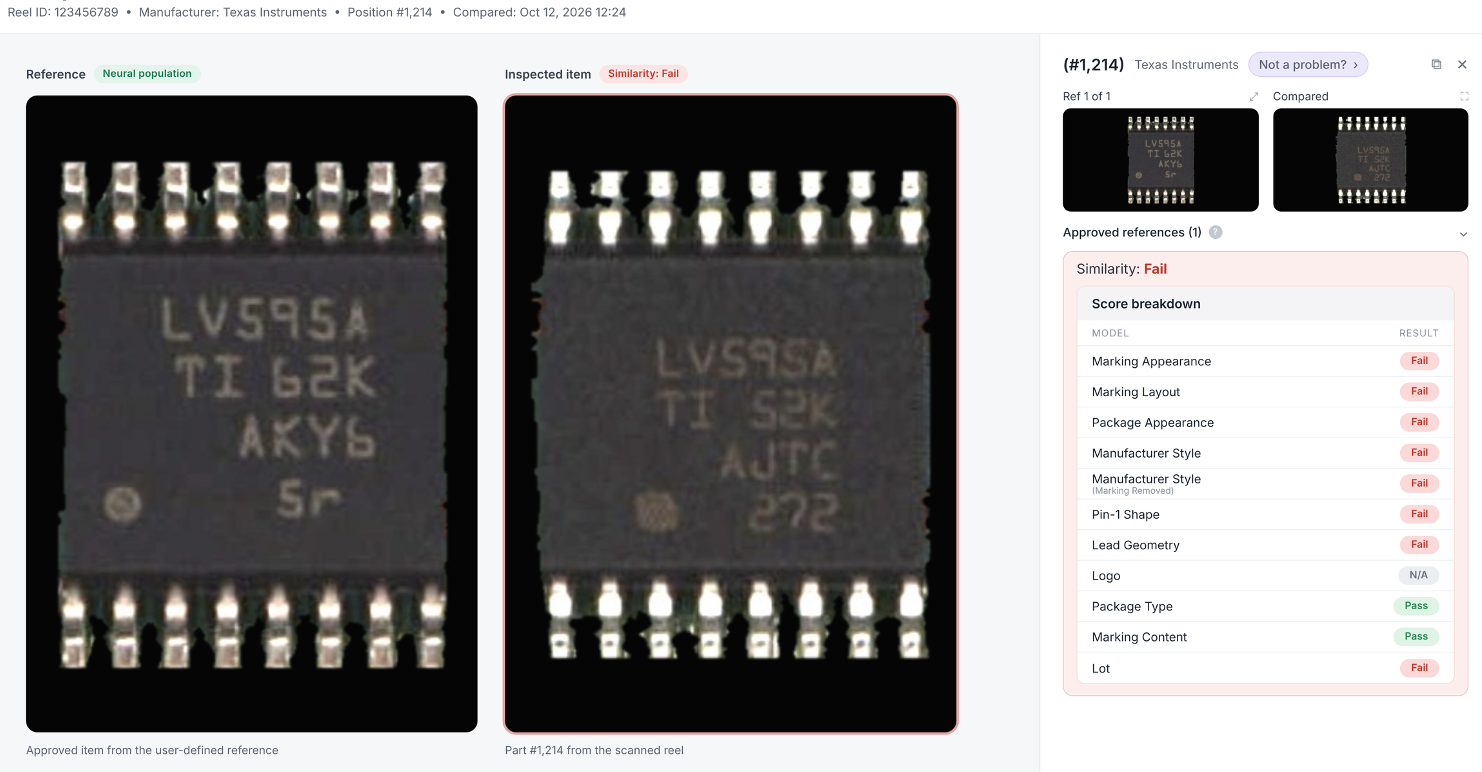
Suspected Counterfeit TI Logic ICs: Although both components are marked as originating from the same manufacturing site (“K”), the inspected component on the right, exhibits noticeable differences in surface markings, Pin 1 indicator, lead geometry, and other physical characteristics, raising concerns about its authenticity. (source: Cybord ShieldScan)
Verify on the line, not on promise
The answer isn’t to stop buying from brokers. Sometimes a broker is the only thing keeping a program alive. The answer is to stop treating the broker’s report as the last check.
Every component, from every source, ends up in the same place: on your board, in front of the automated optical inspection (AOI) system already on the line. That’s where Cybord AI works. Using the AOI images you already capture, Cybord AI verifies every component at line speed. It doesn’t just capture the markings, it deciphers them: manufacturer part number (MPN), manufacturer, date and lot codes, country of origin. It analyzes the physical shape, from body size to leads. Then it compares what it sees to what should be there: does this component match the part you were supposed to get, the one named on the certificate? Surface texture, font type and size, logos and other manufacturer-specific traits are analyzed too, exposing blacktopping, wrong logos and font deviations, the telltale signs of tampering, remarking and counterfeits. No sampling. No new hardware beyond an edge computer.
That changes what a broker buy means:
- A remarked part shows up as a marking that doesn’t match its manufacturer.
- A recycled part shows signs of aging or prior use.
- A mixed reel shows up as date and lot codes changing mid-run.
- A non-approved source shows up against your Approved Vendor List (AVL), in real time, before the board moves on.
All of it is caught at the component level, while the board is still on the surface-mount technology (SMT) line, not after it has been packaged and shipped to a customer.
Every inspected board also leaves a record: which part, from which source, on which board, at which reference designator. If a broker lot turns out to be bad six months from now, you don’t recall a production quarter. You pull the exact units that carry it.
What this means for supply chain leaders
For supply chain and procurement leaders, broker buys stop being a leap of faith and become a measurable risk. You can see how much of your actual consumption came from outside your approved sources, which CMs lean on brokers most, and whether a “one-time” exception quietly became a habit. AVLs reflect intentions. Consumption data reflects reality.
For quality and operations leaders, the broker’s test report becomes one input instead of the final word. The part that reaches your board is verified on its own merits, every time, no matter where it came from.
And for compliance teams, country-of-origin claims attached to a broker shipment can be checked against what’s actually printed on the part, rather than accepted as written.
The promise and the proof
Scarcity isn’t going away. AI build-outs, end-of-life cycles, and trade restrictions will continue pushing buyers toward brokers who promise the chips nobody else can find.
That means OEMs need to take greater control of their own destiny. The industry must stop treating supply chain ups and downs as temporary disruptions and start putting the right tools in place to manage them.
Tough times are part of the business. And yes, some brokers will deliver exactly what they promise.
Your job isn’t to guess which ones. It’s to know what actually ended up on your board.
Anyone can promise a chip. Only verification proves what you got.
(1) Source: https://www.eetimes.com/we-source-chips-others-cannot-secure-2026/