A recent investigation into Royal Navy surveillance drones highlights a growing reality: documentation alone cannot guarantee supply chain security. As component sourcing becomes more complex, OEMs should provide buyers with visual, unit-level proof of every component assembled on every board – not just declarations. Visual AI enables manufacturers to verify component provenance, detect unexpected substitutions, and create evidence-based supply chain assurance using existing AOI images.
One comment quoted in The Telegraph captures the issue succinctly: “This is major failure to check origins of components and we have lost confidence in the platform.”
# # #
A recent investigation by The Telegraph revealed that surveillance cameras installed on Royal Navy unmanned vessels contained Chinese-made components that were transmitting “heartbeat” communications to an IP address in China. According to the report, the cameras had been supplied through a trusted defense contractor, based on assurances from a third-party supplier, until routine security testing uncovered the issue.
The story will undoubtedly fuel discussions about cybersecurity, procurement policy, and trusted suppliers.
But there is another lesson here – one that reaches far beyond defense.
The Question Isn’t Who You Bought From
The investigation found that the cameras were sourced through legitimate channels. Documentation existed. Assurances had been given. Yet components with unexpected origins still made their way into operational military systems.

That exposes a fundamental weakness in today’s electronics supply chain:
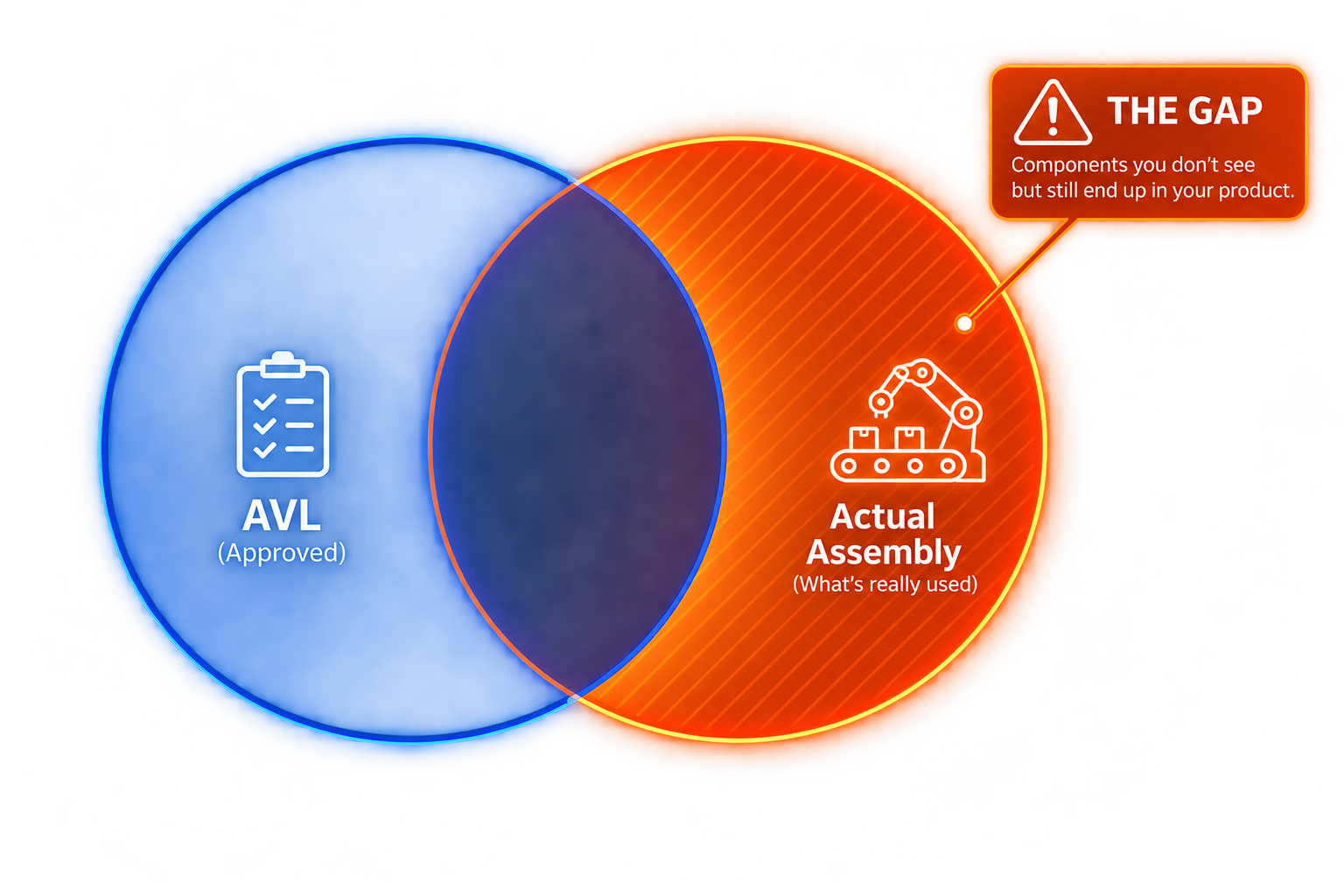
Most organizations know what should be on a board. Far fewer know what is actually on the board.
Those are two very different things.
Bills of materials, certificates of conformity, supplier declarations, AVL records, and procurement documents all describe the intended supply chain.
They do not prove the physical reality of every assembled system.
Documentation Isn’t Evidence
Modern electronic assemblies routinely contain hundreds, or thousands, of components sourced through complex, multi-tier global supply chains.
Between component manufacturers, distributors, brokers, EMS providers, subcontractors, and last-minute substitutions, a great deal can change between purchasing and final assembly.
In many cases, OEMs themselves cannot produce definitive, unit-level evidence showing:
- Which exact components were assembled on a specific board
- The markings visible on each component
- The manufacturer and country of origin
- Whether substitutions occurred during production
- Whether every component matched procurement and design requirements
Instead, the industry still relies largely on paperwork.
Paperwork can be incomplete.
Paperwork can be outdated.
Paperwork can be wrong.
And, as this incident illustrates, paperwork can provide false confidence.
Trust Needs Visual Evidence
Imagine a different procurement model.
Instead of receiving only a declaration that a product complies with sourcing requirements, every delivered system includes a visual, unit-level record of every assembled component.
Not a sampling inspection.
Not a laboratory teardown.
Not an audit performed months later.
A complete digital record generated automatically during manufacturing using the AOI images already captured on SMT production lines.
This provides buyers with evidence – not assumptions.
For every board, they can verify:
- The actual component installed
- Component markings
- Manufacturer identification
- Country of origin
- Approved versus unexpected substitutions
- Assembly deviations before products leave the factory
In regulated industries, that record becomes as valuable as the product itself.
Component Provenance: Buyers Should Raise the Bar
Defense organizations are understandably increasing scrutiny of component provenance.
But the same challenge exists across aerospace, medical devices, industrial automation, transportation, critical infrastructure, and data centers.
The question procurement teams should begin asking suppliers is no longer:
“Can you certify where these components came from?”
It should be:
“Can you show us?”
Visual proof creates a level of transparency that declarations alone cannot.
It shifts supply-chain assurance from trust-based to evidence-based.
Supply Chain Assurance Is Becoming Unit-Level
One comment quoted in The Telegraph captures the issue succinctly: “This is major failure to check origins of components and we have lost confidence in the platform.”
That loss of confidence wasn’t caused solely by the components themselves.
It was caused by the fact that no one knew they were there until after deployment.
As supply chains become more complex and geopolitical risks continue to reshape electronics manufacturing, provenance can no longer exist only in procurement systems.
It must exist on the product itself – in the form of verifiable, visual evidence.
Because when the question becomes “What’s actually on this board?”, documentation is no longer enough.
You need proof. And in modern electronics manufacturing, that proof should be visual.
# # #
Q: Aren’t supplier declarations and certificates enough to prove component provenance?
Supplier declarations, certificates of conformity, and bills of materials describe what should have been assembled, not necessarily what was actually built. Components can change throughout the supply chain due to substitutions, sourcing changes, or procurement decisions. Visual verification provides physical evidence of what is actually present on each individual board.
Q: What does “visual proof of component provenance” mean?
Visual proof is a digital record showing the actual components assembled on a specific PCB. Using visual AI to analyze PCBA images, manufacturers can identify component markings, manufacturer information, country of origin, and unexpected substitutions, creating unit-level evidence rather than relying solely on documentation.
Q: What should OEM customers ask their electronics suppliers?
Instead of asking, “Can you certify where these components came from?”, buyers should ask, “Can you show us?” OEMs should be able to provide visual evidence of the components assembled on every delivered board, enabling customers to independently verify provenance, compliance, and supply chain integrity.
# # #