A report published last week by Newswise* carried a line that will feel familiar to anyone who has spent time in defense electronics procurement: counterfeit and out of spec components are entering U.S. defense supply chains, and contractors are finding they cannot confirm the parts they buy are genuine without independent verification. Not because nobody is trying. Because the record most contractors rely on, the paperwork that travels with a part, was never designed to answer that question on its own.
That distinction, between having data about a part and having verified data about a part, is the one worth sitting with.
Why risk years of design and qualification on one bad component?
Defense electronics sit at the intersection of two pressures that are both intensifying. Programs are diversifying suppliers to reduce single source risk and meet domestic content requirements, which means more components are entering the supply chain from sources with a shorter track record. At the same time, defense programs often need to support systems for decades, long after some of their original components have become obsolete or difficult to source. That pushes procurement beyond established suppliers and into increasingly complex, multi-tier supply chains.
The components themselves are also doing more safety and mission critical work than in prior generations of hardware. A counterfeit or mismarked part is not a warranty problem in this context. It is a mission readiness problem, and in the worst case, a safety one.
The Newswise report’s framing, that the data behind a part now matters as much as the part itself, gets at something contractors have known for a while but rarely say out loud: a part’s paperwork, the certificate of conformance, the supplier’s declaration of origin, the lot documentation, is a claim. It is not a measurement. And a claim is only as trustworthy as the process that produced it.
Where paperwork based trust falls short
Most qualification and receiving processes today are built around exactly this kind of claim. A supplier attests that a shipment meets spec, provides documentation, and that documentation becomes the record a contractor relies on if a customer, an auditor, or a program office ever asks where a part came from.
The challenge in defense is that the contractor may be several tiers removed from the original component source. A hard-to-find or obsolete part may pass through distributors, brokers and other intermediaries before reaching production. Each additional tier adds another layer of declarations and paperwork – and another point where visibility into the actual component can be lost.
It works well when suppliers are established, audited, and known. It works far less well as the supplier base widens, because a new source’s documentation carries the same formal weight as an established source’s, whether or not the underlying part matches it.
This is where counterfeit and out of spec parts find room to operate. A remarked component, a recycled part relabeled as new, a substituted part from an unapproved vendor, or a part from the wrong country of origin can all travel with documentation that looks correct on its face. Nothing in a paperwork based system catches that, because paperwork based systems were built to confirm that a process was followed, not to confirm what is physically inside the box.
Verifying the part behind the data
This is the layer that has to sit underneath the documentation, and it is the specific problem Cybord’s AI solution is built to address. Using images of assembled boards captured on the production line in real-time, Cybord checks each component against its manufacturer part number, lot and date code, and country of origin, at line speed, rather than reconstructing that information later from a supplier’s paperwork. The verification happens against the physical part itself, not against a description of it.
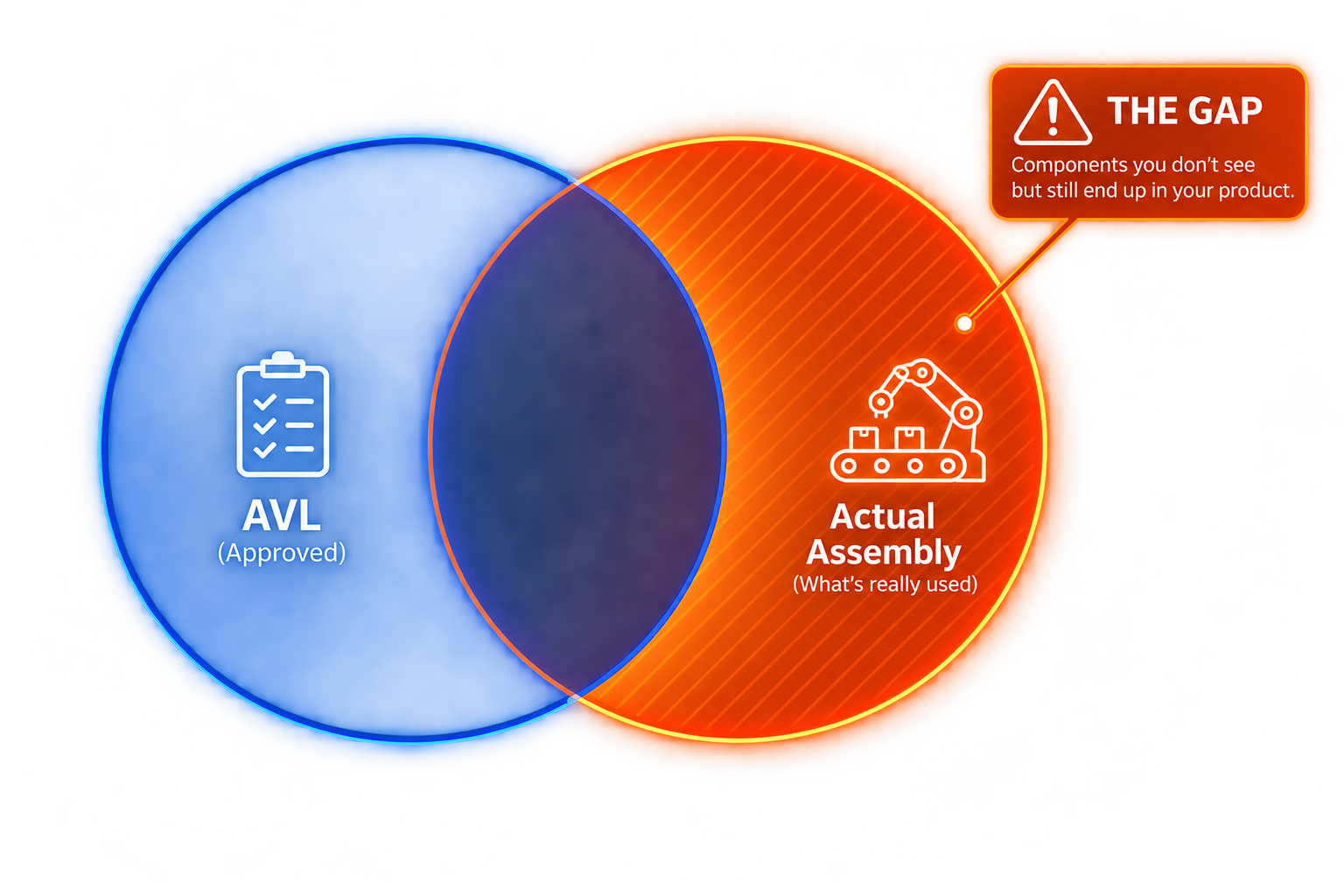
That changes what “the data behind a part” actually means. Instead of a certificate that says a part should be genuine, a contractor has a captured, timestamped record of what was actually placed, checked at the moment it entered the board. That creates a traceable record of what was actually built into each product – not simply what the BOM, AVL or supplier documentation says should have been built.
If a supplier’s documentation and the physical part ever diverge, that divergence is caught during assembly, not months later during an investigation or, worse, after the part has failed in the field.

Hardware integrity verification using visual evidence (Source: Cybord)
Are you checking the actual part, or just the paperwork?
For defense contractors and their multi-tier supply chains, the practical question raised by this report is not whether counterfeit and out of spec parts are a real risk. That much is established. The question is whether your current verification process actually checks the part, or only checks that someone filled out the right form about the part.
That distinction becomes even more important when a component has passed through two, three or more tiers before reaching the assembly line. Do you actually know what is inside your product – who made it, where it came from, whether it is approved and whether it is genuine – or do you know what the paperwork says?
Widening the supplier base is not optional in the current environment, and it should not be. But every new supplier added without component level verification behind their paperwork is a new claim a contractor is choosing to trust rather than confirm. That is a different risk posture than most quality teams believe they are operating under.
Earning the trust the paperwork can’t
The Newswise report is right that the data behind a part now matters as much as the part itself. Where I would push the point further is that the data only matters if it is verified, not just recorded. A supplier’s attestation and a contractor’s independent, component level confirmation are not the same kind of evidence, even when they describe the same part.
As defense programs keep widening their supplier base under compliance and readiness pressure, the contractors who pair every new source with real verification, checked component by component as parts are placed, will be the ones who can answer with certainty, not paperwork, when it matters most.
* https://news.research.gatech.edu/2026/08/14/why-data-behind-part-now-matters-much-part-itself