An Earthquake Exposed More Than a Supply Chain Risk. It Exposed a Visibility Problem.
By Oshri Cohen, CEO, Cybord
On July 28, 2026, a magnitude 7.1 earthquake struck Japan’s Kumamoto Prefecture, home to one of the world’s most concentrated semiconductor manufacturing regions. Within days, industry analysts were assessing the potential impact on global electronics production, as OEMs and EMS providers considered whether they would need to activate alternate sources for critical components.
For many in the industry, it was an unwelcome reminder of the disruption that followed the 2011 Fukushima disaster, when a regional catastrophe triggered months of shortages across the global electronics supply chain.
Natural disasters like this inevitably raise concerns about supply continuity. But they also expose a different – and often overlooked – question:
How diversified is your supply chain, really?
Most manufacturers would answer confidently. They have approved vendor lists, qualified second sources, and procurement policies designed to avoid dependency on any single supplier. On paper, the strategy is sound.
The problem is that policies are not the same as visibility.
The Diversification Gap
Supplier concentration rarely happens overnight. It develops gradually.
One supplier consistently delivers on time. Another offers better pricing. An EMS provider naturally purchases from its preferred distributor. Over months or years, sourcing decisions begin to converge. The approved alternatives remain on the AVL, but production quietly becomes dependent on a much smaller group of suppliers than anyone realizes.
Unless you’re measuring what is actually being assembled onto finished products, that shift often goes unnoticed.
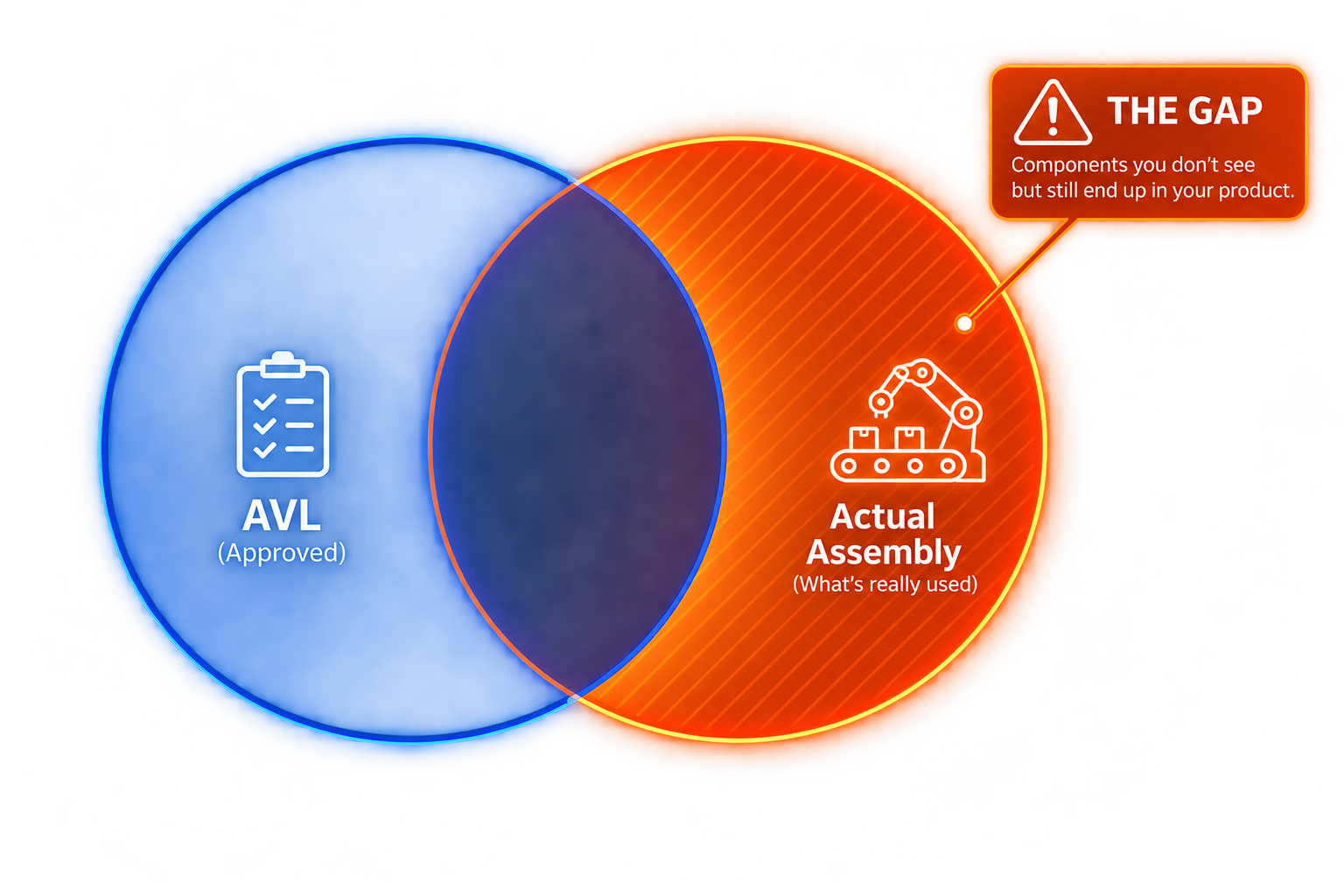
Recently, one of our OEM customers used Cybord’s Visual AI platform to compare its approved vendor list (AVL) with the components assembled across production. On paper, the sourcing strategy looked exceptionally well diversified: fewer than 2% of approved components relied on a single supplier, while nearly 99% had at least one approved alternative. Yet the production data told a very different story. Nearly 30% of the components actually installed on finished products came from a single source, despite those approved alternatives being available all along.
Nothing violated procurement policy. Purchasing decisions had simply converged over time, creating a level of supplier concentration that nobody realized had developed.
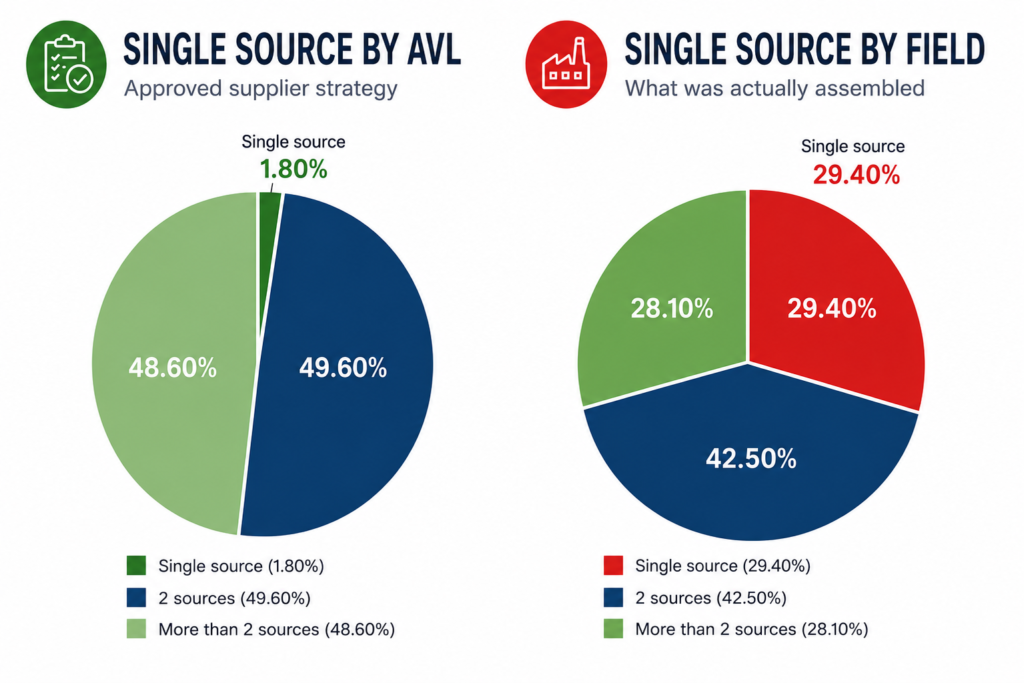
AVL planning vs. actual assembly data (source: Cybord T-Scan micro-traceablity)
Supplier diversification isn’t just about having alternatives on paper. Maintaining active relationships with secondary suppliers matters as well. Suppliers that receive little or no business over long periods naturally become lower priorities for engineering support, inventory allocation and production capacity. When a disruption forces a rapid sourcing change, rebuilding those relationships is far more difficult than simply selecting another approved part number from an AVL.
Disruptions Don’t Create Risk. They Reveal It.
The earthquake in Kumamoto didn’t suddenly make supply chains vulnerable. It simply highlighted dependencies that were already there.
When a disruption forces procurement teams to source components differently, the first challenge isn’t qualifying a new supplier. It’s understanding how concentrated current production has already become.
If an organization doesn’t know where today’s components actually originate, it’s difficult to assess how much exposure exists – or whether diversification efforts have been successful in practice.
Measuring What Matters
Traditionally, supplier diversification has been measured through documentation: approved supplier lists, purchasing records and sourcing policies.
Those remain important.
But documentation cannot confirm what has actually been assembled onto every individual product.
Visual AI adds another layer of assurance by identifying the physical components installed on every board, allowing manufacturers to continuously measure supplier concentration, verify country of origin, and understand where production has become overly dependent on specific manufacturers, fabrication facilities or regions.
Instead of assuming diversification is working, manufacturers can measure it.
Resilience Requires Evidence
Natural disasters, geopolitical events, export controls and factory shutdowns will continue to test global electronics supply chains. No organization can prevent those events.
What they can control is how well they understand their own exposure before disruption occurs.
A supplier diversification strategy is an important first step. But resilience isn’t determined by how many approved suppliers appear on an AVL. It’s determined by what is actually being assembled onto products leaving the factory today.
Because when the next disruption arrives, the companies that respond fastest won’t necessarily be the ones with the longest supplier lists.
They’ll be the ones that already know where their real dependencies lie.