The Challenge: Lack of Inline Visibility

Electronics manufacturers often face significant hurdles in ensuring the quality of their products. Traditional quality control methods can be time-consuming, do not cover 100% of the material, and not provide the real-time insights needed to prevent defects. This lack of inline visibility can lead to costly recalls and damage to a company’s reputation.

The Solution: Cybord QCI

Cybord QCI offers a revolutionary approach to quality assurance by analyzing the bottom image of each component. This advanced  AI system assesses the quality of each component and collects all necessary data to achieve 100% traceability.

With Cybord QCI, manufacturers can significantly reduce the likelihood and cost of defective products and recalls.

Key Features

  • Real-Time Analysis: Cybord QCI provides instant analysis of each component, ensuring that any defects are identified immediately.
  • 100% Traceability: The system collects comprehensive data on each component, making it easy to trace any issues back to their source.
  • Instant Alerts: If a problem arises, Cybord QCI sends an instant alert with all the information needed to trace the issue down to the specific board and faulty component and redirect the board with the faulty component to the Non Magazine at the AOI station for rework

Benefits of Cybord QCI

Implementing Cybord QCI in your manufacturing process offers several key benefits:

  • Reduced Recalls: By identifying defects in real-time, Cybord QCI helps prevent faulty components from reaching the market, thereby reducing the likelihood of recalls.
  • Cost Savings: Fewer recalls mean lower costs associated with fixing issues and managing customer dissatisfaction.
  • Improved Reputation: Consistently high-quality products enhance your brand’s reputation and build customer trust.

Conclusion

Cybord QCI is a game-changer for component manufacturers looking to improve their quality control processes. By providing real-time analysis, 100% traceability, and instant alerts,

Cybord QCI helps manufacturers maintain the highest quality standards while reducing costs and protecting their brand reputation.

If you’re in the manufacturing industry, it’s time to consider integrating Cybord QCI into your quality control strategy.

Related Posts

Sourcing funner

An Earthquake Exposed More Than a Supply Chain Risk. It Exposed a Visibility Problem.

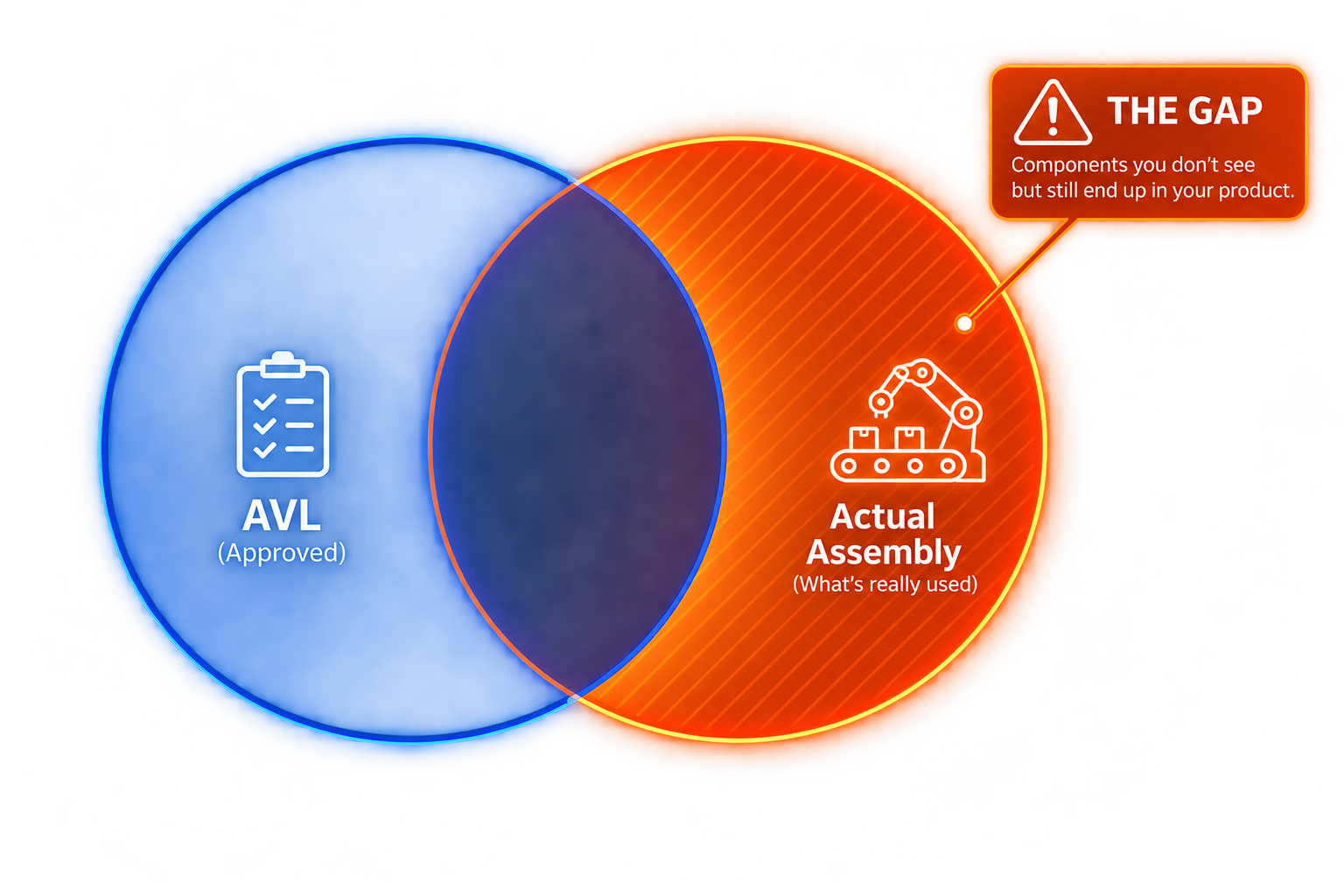
The recent Kumamoto earthquake is a reminder that regional disruptions can quickly ripple through the global electronics supply chain—just as the Fukushima disaster did in 2011. Most OEMs have supplier diversification policies and approved alternative vendors. The real question is whether those alternatives are actually being used in production. In one OEM analysis, the Approved Vendor List (AVL) showed a highly diversified sourcing strategy, yet production data revealed that nearly 30% of components were sourced from a single supplier, creating a hidden concentration risk. Supply chain disruptions don't create hidden dependencies—they expose them. Visual AI enables manufacturers to continuously measure supplier concentration from the products they actually build, turning diversification from a policy into a measurable reality.

Who Verifies the Chip That Verifies Everything Else?

Intel and Fortinet are jointly developing Fortinet's next generation security processor, SP6, in part to build a more resilient, diversified supply chain. A security chip is still a chip. Once SP6 leaves the fab, it has to survive the same assembly process as every other component, the process where substitution and counterfeiting actually happen. Standard checks, documentation, batch traceability, sampling, confirm what should be true. Only Visual AI, verifying every component's markings, lot and date code, and country of origin as it's placed, confirms what is true. Cybord has already flagged over 30 major non-AVL substitution events in the first six months of the year. None were counterfeits. All were wrong parts that reached the line undetected by standard inspection. For telecom and datacom OEMs, the question isn't whether SP6 performs. It's whether you can prove the SP6 on the board is the genuine part, at the silicon level, every time.

The Tectonic Shift in Electronic Supply Chain Assurance

DFARS Case 2022-D011 marks a shift from documentation to proof, requiring defense suppliers to verify hardware provenance rather than rely solely on paper records. The new rule secures where PCBs come from, but not what gets assembled onto them, leaving component-level risks such as counterfeits, substitutions, and unauthorized parts largely unaddressed. Traditional inspection tools verify manufacturing quality—not component authenticity. Visual AI adds evidence by analyzing the physical characteristics of every installed component to confirm it matches approved hardware. As provenance requirements continue to expand, manufacturers that can provide image-based proof of authentic, approved hardware will gain both a compliance and competitive advantage

Accessibility Toolbar