
As global supply chains navigate complex geopolitical risks and rising threats, a major shift is underway in electronics manufacturing, driven, in part, by industry leaders. Recent reports indicate that Tesla is intensifying its strategy to exclude Chinese-made components from its US electric vehicle plants, requiring suppliers to replace all such remaining parts within the next one to two years. This news comes on the heels of Nexperia’s announcement earlier this month that it cannot guarantee quality of its chips made in China since October 13, 2025.
By Yoel Knoll, Cybord
The rigorous push for Country of Origin (COO) compliance demands far more than traditional paperwork can provide. It necessitates a technology capable of enforcing verification not just at the reel or batch level, but at the individual component level – a capability known as micro-traceability.
The End of Blind Trust in Manufacturing
Traditionally, manufacturers relied on safeguards like sample-based inspections, supplier certifications, or basic data logging. These methods, however, are operating under outdated assumptions, especially when complex electronic assemblies involve hundreds or thousands of components, often outsourced to third-party suppliers. Conventional methods fail to secure the integrity of every component placed on a circuit board.
Today, the real risk lies in subtle hardware-level manipulations such as covert tampering, unauthorized substitutions, and even counterfeit components that bypass high-level security mechanisms. When dealing with mission-critical systems, like those in electric vehicles, airplanes and electrical power, simply trusting that components are valid once documented is no longer viable.
The Ideal Solution: Vision-AI Inspection
The requirement to verify the COO of every tiny component points directly to the power of AI-powered visual inspection systems. These systems are uniquely positioned to meet strict demands like the ones announced by Tesla because they inherently “see” what others miss.
Vision-AI involves capturing high-resolution images of every electronic component, both before and after it is mounted on the Printed Circuit Board (PCB). One way of doing this is by utilizing existing cameras on production line equipment, such as Pick & Place (PnP) and Automated Optical Inspection (AOI) machines.
This AI-driven visual inspection technology is capable of advanced analysis:
- Analyzing assembled circuit boards: to verify every component matches approved specifications and suppliers ensuring integrity by detecting missing, swapped, misplaced or unauthorized parts.
- Reading and Deciphering Markings: Advanced visual AI models perform top-side inspection to read and decipher component markings, accurately interpreting manufacturers’ specific coding and variations.
- Extracting Granular Data: From these physical markings, the AI extracts vital information, including physical attributes, placement data, Manufacturer Part Number (MPN), lot code, date code, and, critically, metadata such as country of origin and supplier.
- Creating a Digital and Visual Record: This verification process creates a complete digital record of every inspected component and board, offering a forensic layer of visibility.
Enabling Approved Vendor List (AVL) Enforcement and Integrity
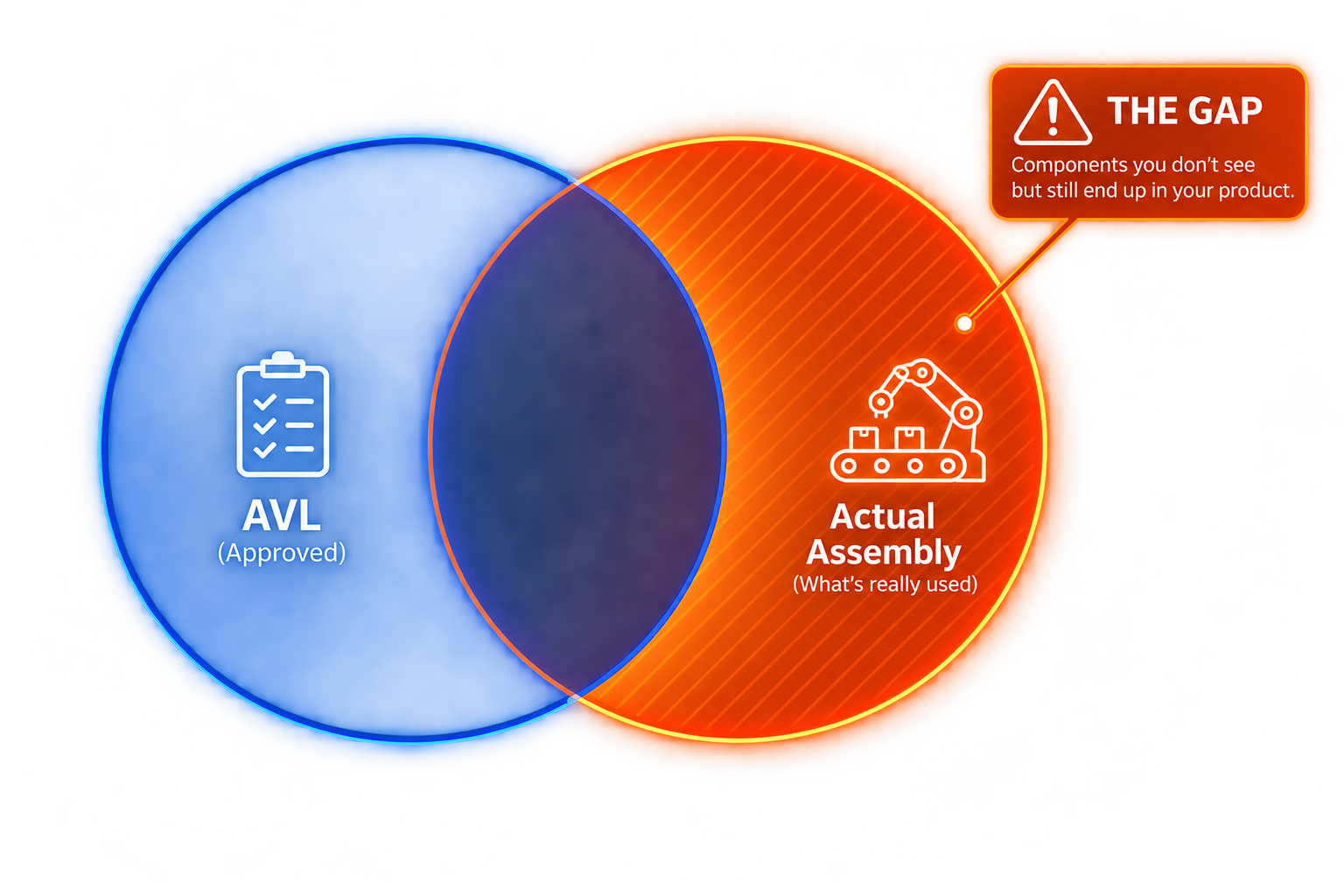
This level of detail is transformative for product integrity and compliance. The AI-extracted data is instantly compared against the OEM’s Bill of Materials (BOM) and its Approved Vendor List (AVL). If a component doesn’t match what is expected – for example, if a part from an unapproved vendor or an unapproved country of origin is mistakenly placed – it is automatically flagged. This real-time component-level verification ensures that supply chain documentation aligns precisely with physical reality.
By identifying and intercepting deviations like non-AVL components, counterfeit parts, or mis-binned grades immediately on the production line, manufacturers can meet policy and regulatory requirements while avoiding costly rework, warranty claims, and major safety risks. This unmatched micro-traceability, allows any future quality issue to be traced back to a specific component or supplier in minutes.
The Start of a Global Trend
Tesla’s demand for component-level COO enforcement signals a wider, urgent shift toward what is being called Zero Trust Manufacturing. In a world where electronics fly planes, stabilize power grids, and steer cars, every unverified component is a potential liability.
The principle is simple: assume nothing is safe until it’s verified. As geopolitical pressures grow and complex electronic failures – including Tesla’s recall of over 200,000 vehicles in early 2025 for a faulty computer module3 – cost the industry billions. This meticulous approach is becoming essential across all high-stakes sectors, including aerospace, defense, power-grids, and datacenters. Moving from trust by default to trust by inspection is no longer optional; it is necessary for securing hardware integrity and ensuring traceability across the global supply chain – on a microscopic, component level.
This shift demonstrates that just as a fingerprint identifies an individual, micro-traceability via Vision AI identifies the provenance and integrity of every electronic component, providing the confidence that global manufacturers now desperately need.